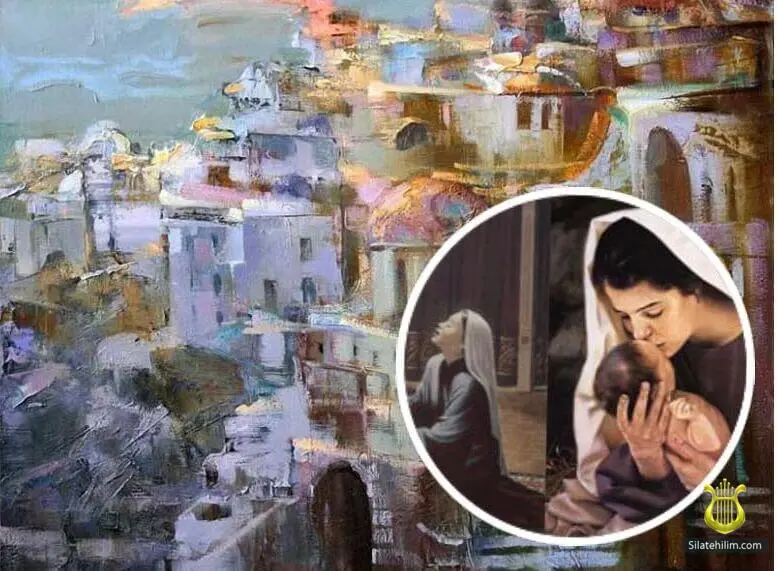
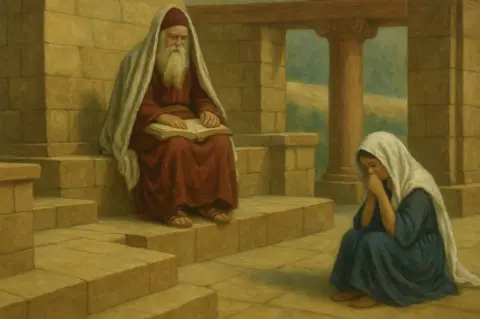
Hannah and Peninnah — a Reward for Tzarot, or: Do Not Oppress
Chazal teach that one must be extremely careful with people who have endured tzarot —
“tzarah” (trouble and oppression).
This is in addition to widows and orphans, about whom the Torah speaks explicitly: “You shall not ill-treat any widow or orphan… If you do mistreat them…! For if they cry out to Me, I will surely heed their cry; My anger shall blaze forth, and I will put you to the sword, and your wives shall become widows and your children orphans.” (Shemot 22:21–23)
The Sages cite the stories of childless women (as exemplified by Hannah), women abandoned by their husbands (Nitzavet bat Adiel), and people who suffered loss (Job and his friends)—and in all these stories, the L-rd rewards those who endure trials and punishes oppression.
All these examples reveal that the trials sent into this world come from the L-rd, and that it is impossible to understand or see the cause-and-effect relationship behind them. Indeed, the question of
“why the righteous suffer while the wicked prosper” runs like a refrain throughout the Torah and remains unanswered.
Hannah and Peninnah
The First Book of Samuel tells the story of Elkanah, who had two wives. Hannah was Elkanah’s first wife; after they had been married for ten years and Hannah had borne him no children, he married Peninnah.
The Midrash
“Pesiqta Rabbati” writes that Hannah acted like our matriarch Sarah—she brought a rival wife into the home: “If I tell Elkanah to take another wife, G-d will see that I have brought in a rival wife and will remember me.”
Peninnah had ten sons, and her children are mentioned briefly in the Book of Kings in connection with the offerings.
We learn this from Elkanah’s question to Hannah: “Am I not better to you than ten sons?”
He therefore sought to comfort Hannah, asserting that his love surpassed the love of ten sons of Peninnah.
The First Book of Samuel (1:6) tells of the tension between Peninnah and Hannah, caused by Hannah’s infertility: “Her rival would taunt her year after year, whenever she went up to the House of the L-rd, so that she wept and would not eat.”
The Midrash reveals how Peninnah tormented Hannah: “Have you not bought a shirt for your eldest son?” (Midrash Samuel 1:8).
Another midrash,
“Pesiqta Rabbati,” says that Peninnah would rise early in the morning and ask Hannah: “Are you not getting up to wash your children before they go to school?” Then, several hours later: “Are you not going to meet your children when they come home from school?” According to this midrash, Peninnah taunted Hannah every day, reminding her of the difference between them.
Another midrash adds that when Elkanah distributed the offerings among his sons, Peninnah would say to her husband: “Give this son of mine his portion,” or, “You have not given this son of mine his share”—all in order to anger Hannah. Peninnah caused her rival pain in every possible way. She knew that Hannah was Elkanah’s beloved wife and also sought to gain some recognition from him, either in their home or in the distribution of the offerings.
It was precisely this behavior on Peninnah’s part that ultimately led to Hannah being blessed with a child.
The Midrash says that G-d answered Peninnah on Hannah’s behalf:
“You oppress
(harimah) Hannah, yet there is no thunder
(ra’am) that is not accompanied by rain. I will remember her immediately [that is, I will bless her with a child].”
Here the Midrash presents a play on the word
“ra’am”—both thunder and anger.
A barren woman is compared to parched earth, and her blessing with a child is portrayed as rain that falls and saturates the soil, bringing forth its fertility.
Hannah conceived and gave birth to three sons and two daughters. The Midrash says that when Hannah gave birth to her children, Peninnah was punished: for every child Hannah bore, the L-rd took two of Peninnah’s children. Hannah bore four, while Peninnah buried eight. When Hannah was pregnant with her fifth child, Peninnah feared that she would lose her last two sons and came to Hannah: “I know that I have sinned against you. Please pray for me so that my two remaining sons may live.”
Hannah prayed to G-d and said: “Please leave her two sons and let them live.”
Although Hannah gave birth to only five children, she says in her prayer: “The barren woman bears seven, while the mother of many languishes,” because Peninnah’s two sons were now considered Hannah’s sons as well.
Although the Midrash says that Peninnah was motivated by good intentions—to inspire Hannah to pray more and with greater fervor—we nevertheless see how strictly the L-rd holds a person accountable for a lack of compassion toward another. (Based on the midrash
“Pesiqta Rabbati” 43)
Hannah’s Prayer is one of the most powerful prayers, and it served as the basis for the central Jewish prayer, the
Amidah; through it, she merited a son, Shmuel.
Hannah’s Prayer (transliteration)
Prayer of Hannah (Transliterated)
Hannah’s Prayer — How to Reach the Heavens
Hannah’s Prayer – How to Reach the Heavens
Hannah’s Prayer — A Special Segula for the Month of Kislev
Hannah's Prayer – A Special Segula in the Month of Kislev
Hannah’s Prayer and the Amidah
Hannah’s Prayer and the Amidah
Was this helpful?
100% of readers found this article helpful (30 votes).
Please note: some articles on our site contain the holy Names of the Almighty. If you print these articles, they may not be thrown away or destroyed. Please handle printed copies with care and respect.