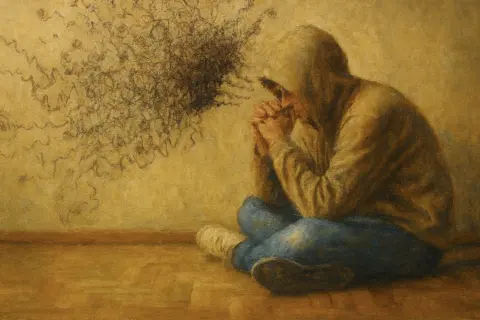
Rabbeinu Chida writes that kaas (anger) has eight names, each corresponding to its effect: kaas, za'am, af, evrah, haron, hemah, ketzef, rogez.
If we rearrange the letters of the word kaas, we get the word ahas—and this is הרס (destruction). Just as the venom of the nachash (snake) poisons the soul, so too all the other names for anger affect the soul of one who becomes angry or enraged.
One should perform a Tikun Kaas, because the neshamah of an angry person departs during an outburst, and a neshamah temeah enters the body. It must be driven out, and one's pure neshamah returned.
The human organ responsible for kaas (anger and rage) is the kaved—the liver.
Tikunim and Segulot for Anger1. “Tikun Kaas” of the Kabbalist Rabbi Salman Mutzafi
Before Shabbat, one should go to the mikveh. The gematria of mikveh is 151, and one should immerse 151 times. It is good to perform the Tikun Kaas at the same time as the Tikun Avonot (rectification of the Patriarchs): undertake a ta'anit for 151 days, or fast for one day and give tzedakah on the other days equal to the amount one would have spent on food that day;
2. The Prayer of Rabbi Aharon Zakai
As soon as a person begins to get angry, he should leave and recite the prayer of Rabbi Aharon Zakai from the sefer Moshel Ruach;
3. Iggeret HaRamban—a good segulah for kaas; read it word for word, without rushing;
4. A Segulah Associated with Adam HaRishon—look at one's fingernails during an episode of anger;
5. The Segulah of Rabbi Nachman of Breslov with Tzitzit for anger;
Rabbi Nachman of Breslov taught that a good segulah for anger is to look at the corner of the tzitzit, the kanaf—its gematria is 150, the same as the word kaas (anger).
“Kanaf” כנף has the same gematria as the word נעל “na'al” (shoe). Thus, when you are angry, visualize the word kaas while holding the kanaf (corner) of the tzitzit in your hands, and then visualize the anger leaving through the shoe and entering the ground.
6. The Segulah of the Baal Shem Tov: Reciting the Pasuk from Tehillim 119:9
בַּמֶּ֣ה יְזַכֶּה־נַּ֭עַר אֶת־אָרְח֑וֹ לִ֝שְׁמֹ֗ר כִּדְבָרֶֽךָ
— “Bameh yezakeh na'ar et orcho lishmor kidvarecha” — (How can a young man keep his way pure? By guarding it according to Your word.)
7. Mikveh—also calms anger, since the word mikveh has a gematria of 151, one more than the gematria of kaas (150). The Tikun Kaas consists of immersing in the mikveh of Shemayah and Avtalion151 times. This is very important, because during an outburst of anger a person loses all his merits and becomes vulnerable to the entry of the forces of the Sitra Achra.
8. One who becomes angry loses his parnassah, while one who can restrain himself in a moment of anger will merit a good livelihood or a gift from Ha-Shem.
9. The Zohar HaKadosh, in Parashat Vayera, p. 26, writes that looking at a child's face is a segulah capable of stopping anger.
Our Sages said: “One who becomes angry is controlled by all types of Gehinnom,” and they add that the root of anger lies in pride. When a person feels that his honor has been violated or that he has not achieved what he wants, he becomes angry. It is important, however, for a person to know that anger itself desecrates the holiness of his Divine soul.
10. “Tikun Kaas” with the Names of Ha-Shem
It is good to perform this segulah with kavanah focused on two Names of Ha-Shem. If we take the rashei tevot—the initial letters—of the first pasuk of Tehillim 119, ב, we obtain בינאאלכ, whose gematria is equal to that of the two Names of Ha-Shem that calm anger:
— The first Name, שב, in milui (expanded form), יודהיווהי, has a gematria of 62;
— The second Name, בן, in milui, ה - יודההווהה, has a gematria of 52. Together, these two Names have the same gematria as the rashei tevot בינאאלכ.
11. “Tikun Kaas” at the Kever of a Tzadik
When the Tzadik Nistar arrived at the grave of the holy Tanna Rabbi Yochanan ben Nuri (a companion of Rabbi Akiva), he noted that this place has the power to save a person from anger, which causes tremendous harm to the soul and also removes all a person's abundance and acts of kindness.
He added that one who tears his clothing, breaks dishes, and so forth in anger behaves like an idolater; the yetzer hara does with him whatever it wishes.
The Zohar HaKadosh writes (in Parashat Pekudei) that when a person is destined to receive abundance in sustenance from Heaven, the “Samech-Mem” descends and provokes him in order to take all that abundance away from him.
Light a candle in honor of the holy Tanna Rabbi Yochanan ben Nuri and ask to be freed from anger (you may also ask on behalf of family members).
(Based on the teachings of Gaon Rabbi Ben-Zion Mutzafi and Rabbi Yitzchak Cohen, a student of “Matok MiDevash”)
Was this helpful?
100% of readers found this article helpful (88 votes).
Please note: some articles on our site contain the holy Names of the Almighty. If you print these articles, they may not be thrown away or destroyed. Please handle printed copies with care and respect.
Material from our site may be copied for the purpose of spreading Torah, provided a link to Silatehilim.com is included. Any use of the site's material in print publications or for commercial purposes is prohibited without the rights holder's consent.