Tehillim 104 – 10 Types of Pulse and 10 Vowel Signs
Jewish Psychosomatics – 10 Types of Pulse and 10 Vowel Signs
Tehillim 104:24
“...kulam be-Chochmah asita”– ([You] made them all with wisdom).Rabbi Chaim Vital (of blessed memory) wrote in Sha'ar Ruach HaKodesh:
“Know that just as a person's physical illness can be identified through his pulse—and my teacher, the Arizal, of blessed memory, possessed this ability to the fullest extent—it is likewise possible to diagnose an illness of the soul by feeling the pulse.”
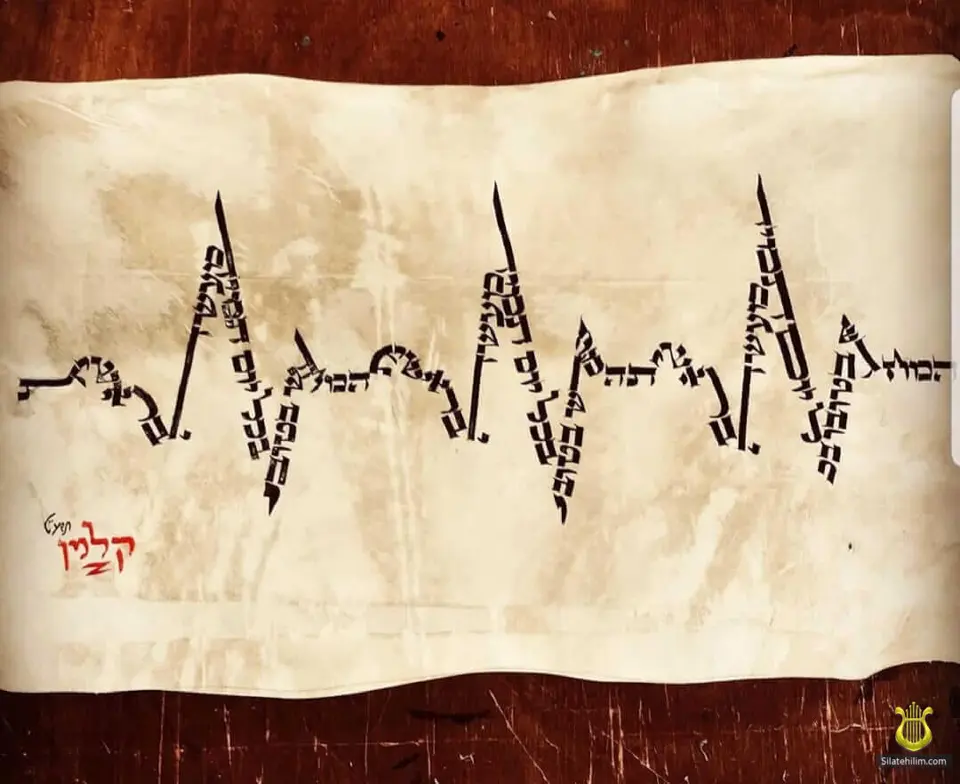
Tehillim 104:24 states: “...kulam be-Chochmah asita”– ([You] made them all with wisdom), meaning that this “wisdom” is expressed through the blood vessels, which are of decisive importance for a person's life force, manifested through the known types of pulse.
For concealed within these pulses is the supernatural life force of Ein Sof [the Infinite], which gives life to all creation.
Ben Ish Chai teaches that the words—“He made everything with Chochmah”—reveal the meaning of the pulse.
What is meant here is Chochmah (wisdom), which is higher than the world of Atzilut. It spreads through the “gidim” (veins and blood vessels) of the spiritual person and manifests in his “dofek” (pulse). That is, Abba (the Father, or Chochmah—Wisdom) manifests in the pulse of the person being animated by the Supernal Man (Zeir Anpin of Atzilut).
It is known that “everything is clarified through thought” (as stated in the section “Heichalot” in the Zohar HaKadosh, Parashat Pekudei)—that “all 320 sparks are clarified through thought.” The aspect of “good [that is, pure] blood”, which is the perfect life force, is concealed within the pulse, while “bad blood” emerges outward.
Because of a person's transgressions, the power of thought is unable to bring the bad blood to the surface and remove it. At that point, the person becomes ill and requires bloodletting to allow it [the blood] to emerge, as is known to physicians who perform bloodletting procedures.
For this reason, a person's entire life force depends on the pulse, and all illnesses can be diagnosed through it.
For according to the transgressions and sins committed by a person, there is a deficiency in the aspect of “light” and life force within the pulse.
The Tikkunei Zohar states that there are 10 types of pulse, each corresponding to the Hebrew vowel signs: kamatz, patach, tzeirei and so forth.
More precisely, all the vowel signs are rooted in Chochmah, as mentioned above, and all the various pulse rhythms correspond to the different forms of the vowel signs.
When a person feels his pulse with his hand, sometimes a pulse consisting of a single beat, “nekudah”, literally (vowel sign), is detected, followed by a beat to the side—this forms the vowel sign “tzeirei”; sometimes there is a single beat that pulses above, with another beat beneath it—this forms the vowel sign “sheva”; sometimes there is a single extended beat accompanied by a short beat, and together they form the vowel sign “kamatz” and so forth.
This applies to all the vowel signs, each of which demonstrates (in accordance with the nature of the life force drawn down at a particular time) and indicates the aspect of Chochmah [in which it is rooted].
It is important to know that pulse diagnosis can reveal and identify the nature of a person's sin.
For example, if a person's pulse resembles “kamatz”, this indicates that he has sinned in relation to Keter, and thus [Keter] dominates at that time, demonstrating that its [negative] force was unable to withdraw because of the person's sin [there is an imbalance].
And we see that when one aspect dominates, this indicates a deficiency in that very same attribute, as it says in Tehillim (104:28): “You hide Your face from them—they perish; You gather in their spirit—they expire and return to their dust.”
Thus, a person's transgressions affect his pulse, where they can be felt and identified. All this was known through Divine inspiration to the sages of the Talmud.
Mishnah says: “Whoever causes the community to be meritorious will not cause them to sin.” (Avot 5:18)
This teaches us that even if a person sins of his own accord, nevertheless, if he influences others to become more worthy, this will protect him, and G-d will immediately forgive him for that particular sin.
And just before a particular transgression begins to affect a person's hand—that is, his pulse—the Holy One, blessed be He, immediately forgives him, before the sin can be detected through the pulse in his hand.
Arteries and Veins
According to Kabbalah, there are 365 blood “vessels” in the body, each consisting of a corresponding “artery” and “vein”. These 365 “vessels” correspond to the 365 negative commandments of the Torah and the 365 days of the solar year.
The difference between arteries and veins is that an artery has a pulse, because the artery corresponds to the day: the daytime is connected with a person's active endeavors, when the pulse of life beats. A vein has no pulse and corresponds to the night—the time of rest and respite from labor.
The sefirah of “Hod” is associated with the body's circulatory system. Interestingly, one meaning of the root of the word “Hod” is “hed” (echo, reverberation). In Tikkunei Zohar (Tikkun 69–108a), it is explained that everything taking place in the circulation of blood throughout all parts of the body reverberates in a person's pulse.
Examining the pulse can reveal much about a person's state of health. Kabbalah teaches that there are 10 basic types of pulse rhythms, corresponding to the 10 vowel signs, which in turn correspond to the inner vitality of the higher Divine sefirot. An experienced physician can feel the patient's distinctive pulse rhythm and thereby correctly diagnose his condition.
Maimonides, an authoritative Torah sage who was also a renowned physician, paid close attention to the pulse when providing medical care.
Rabbi Nachman of Breslov, at the climax of his story about the Seven Beggars, describes the armless beggar—the messianic image of a physician who cares for and heals the king's daughter, the people of Israel (Knesset Yisrael), by measuring her pulse: “You will not be able to heal the king's daughter, because you will be unable to measure her pulse. For there are 10 types of pulse, and you know only one of them, since you are capable of conveying through your hands only one type of wisdom (Chochmah).”(“Bircat Avot” by Baruch Emanuel Erdstein; Rabbi Yitzchak Ginsburgh)
Was this helpful?
100% of readers found this article helpful (46 votes).
Please note: some articles on our site contain the holy Names of the Almighty. If you print these articles, they may not be thrown away or destroyed. Please handle printed copies with care and respect.
Material from our site may be copied for the purpose of spreading Torah, provided a link to Silatehilim.com is included. Any use of the site's material in print publications or for commercial purposes is prohibited without the rights holder's consent.