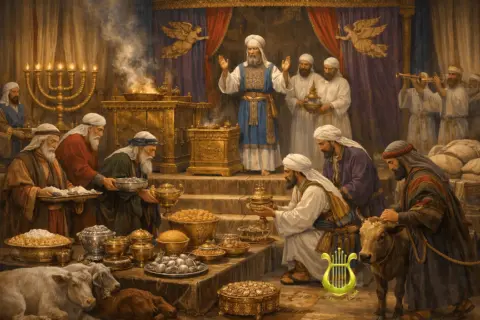
When a person tells stories of the tzadikim—“Sipurei Tzadikim”—on a particular topic related to his trials and difficulties, he may receive help from Heaven.
Baal Shem Tov once said at a brit milah: “One who recounts the glorious deeds of the tzadikim is as if he were engaging in Maaseh Merkavah (the Workings of the Chariot).”
Rabbi Elimelech of Lizhensk explains this in his famous work, “Noam Elimelech”:
“The souls of Israel exist above the angels and the holy chayot, while the lower world is a pedestal for the higher World. The Children of Israel knew that their souls are a Chariot and throne for the higher worlds. Thus, the Baal Shem Tov compared stories about tzadikim to one of the highest forms of serving G-d: studying the mystical secrets of Creation. Stories about the righteous are considered an important spiritual practice that purifies the soul and contributes to the tikkun of the Universe”.
The Maggid of Mezhyrich About the Angel Raphael A learned Jew from Vilna took up commerce in search of a livelihood. He had to travel extensively, and while in Ukraine he heard many stories about the Maggid of Mezhyrich. There, in Ukraine, people spoke about him differently than they did in his native Vilna, which aroused his curiosity, and eventually he decided to investigate the matter himself. He prepared an interesting Talmudic topic and decided to visit this rabbi during one of his journeys. It was not easy to gain admittance to the Maggid. A long line had formed outside the house, but eventually he entered the room. The Maggid did not allow him to say a word. Extending his hand in greeting, he began speaking: “When a doctor treats a sick person, a special angel is sent from Heaven to bring healing. The greater the doctor’s expertise, the more important the angel who is sent. But if he is the best doctor in the world, the angel Raphael himself comes to heal the person.” The Maggid extended his hand in farewell, and the audience was over. The Jew merely shrugged in bewilderment—he had understood nothing. Upon returning to Vilna, he became seriously ill. His fever was high, the medicines did not help, and soon it became clear that his days were numbered. He was greatly loved in Vilna because he had helped many people. Crowds gathered outside his home, arranging minyanim to pray for his recovery and doing whatever they could to help. At that time, the King of Prussia arrived in the city on a visit. His procession happened to be passing along the street beside the house where the sick man lay. Seeing the king’s carriage, the Jews rushed toward him, pleading with him to provide a doctor who could save the man. The carriage stopped, and the king asked an officer of the guard what was happening. The officer replied that all these Jews were shouting and waving their hands, but as far as he could understand their jargon, someone was ill and they were asking for a doctor. The king’s personal physician, an Italian named Lagloria, was sitting with him in the carriage, and the king suggested that he try his skills. When he saw the patient, the doctor became very angry: the man was in agony, and he did not know how to raise the dead. But so many hopeful eyes were fixed upon him that he could not simply leave. He therefore wrote a prescription in Latin for a medicine that could do no harm and sent it to the pharmacist. However, as he took one last look at the patient, the doctor suddenly noticed that something inexplicable was happening—perhaps the man could still be helped. He tore up the first prescription and wrote a second. But the second prescription was unnecessary as well: the patient was visibly recovering. Another prescription had to be written. This happened several times, until, before the doctor’s eyes, the patient made a complete recovery and regained consciousness without any treatment. Upon awakening, he repeated the Maggid’s words to the physician. Upon hearing them, the “Italian” remembered that he was a Jew and felt an acute need to visit this rabbi in Mezhyrich. He left his position and traveled to the Maggid. When he entered the room for the first time, he heard: “I have been waiting for you for a long time. We need one another. You will heal my leg, and I will heal your soul.” Thus the Maggid acquired a disciple who eventually became one of the members of the holy brotherhood of his students. His name was Dr. Rabbi Aaron Gordon. (Based on the book “At the Shabbat Table” by Rabbi Yaakov Doctor) How to Get Rid of Gallstones The Torah states (Devarim, Ki Teitzei 25:15): אֶבֶן שְׁלֵמָה וָצֶדֶק יִהְיֶה-לָּךְ אֵיפָה שְׁלֵמָה וָצֶדֶק יִהְיֶה-לָּךְ לְמַעַן יַאֲרִיכוּ יָמֶיךָ עַל הָאֲדָמָה אֲשֶׁר-יְהוָה אֱלֹהֶיךָ נֹתֵן לָךְ - “Even shleimah va-tzedek yihyeh lecha, ephah shleimah va-tzedek yihyeh lecha, lema’an ya’arichu yamecha al ha-adamah asher Adonai Elohecha noten lach” - (A full and honest weight shall you have; a full and honest measure shall you have, so that your days may be prolonged on the land that the L-rd, your G-d, is giving you.) When Rabbi David ben Hasin, the great Moroccan rav, chazzan, and paytan, decided to publish his book “Tehillah le-David,” he traveled to raise the necessary funds. He reached Amsterdam and went to the city’s main synagogue, where he spoke with the rabbi of Amsterdam. The host held Rabbi David in high esteem and, despite the Amsterdam community’s meticulous adherence to its customs, asked Rabbi David to lead the prayer service according to Moroccan Jewish custom. After the service, the two rabbis went to visit the community leader, who was ill and suffering greatly from pain. Rabbi David asked the sick man what ailed him. The man replied that he had gallstones. Rabbi David blessed him with a verse from the Torah (Devarim 25:13): - “Lo yihyeh lecha ve-kisecha even va-even gedolah u-ktanah” - (There shall not be in your pouch a large stone and a small stone). In Hebrew, the gallbladder is “kis ha-merah”, and a stone is “even.” Using a play on words, Rabbi David ben Hasin recited the prohibition, “There shall not be in your pouch a large stone and a small stone,” intending that there should be no “stones” (even va-even)—neither large nor small—in your “gallbladder” (be-kisecha). Upon hearing this blessing, the sick man burst into such intense laughter that the stones came out with his cough. After calming down, the community leader asked Rabbi David the purpose of his visit. Rabbi David replied that he wished to publish a book of piyutim. The grateful community leader said, “Publish the book, and I will pay all the expenses”—and, concluding with verses from the same chapter of the Torah, but omitting the word “even,” he said: - “Shleimah ve-tzedek yihyeh lach” - (A full measure shall you have). (Based on the book “The Gates of the East” by Yisrael Spector) Pulse Diagnosis by the Baal Shem Tov Once, a distinguished and famous doctor visited a princess in the city, and the princess spoke at length in praise of the Besht, describing what a great man he was and how knowledgeable he was in the art of healing. The doctor said, “Have him summoned; let him come here.” She replied, “That would be disrespectful. A carriage should be sent for him, as for a great nobleman, because he is a great man.” She sent for him, and he appeared before them. The doctor asked him, “Is it true that you are knowledgeable in the art of healing?” The master replied, “Yes, it is so.” He asked, “And where, and under which expert, did you study?” He replied, “The L-rd G-d has granted me understanding.” The doctor found this amusing and asked again whether he could diagnose by the pulse. The master said, “I have an ailment; diagnose it from my pulse, and I will examine and check your pulse.” The doctor felt his pulse and realized that he was suffering from some ailment, but he could not identify what it was. In truth, he was possessed by love of G-d, blessed be He, and such an ailment was beyond the doctor’s understanding. Then the master felt the doctor’s pulse. He turned to the princess and asked her, “Were certain valuable objects stolen from you?” She replied, “Yes. They disappeared several years ago, and I do not know where they are.” The master said, “Send to his estate and have his chest opened. There you will find these objects safe and sound.” She sent at once, and found them there through his Holy Word. The doctor left in shame and disgrace. The explanation is that the Sitra Achra of Abba (father—one of the Divine Faces, or partzufim) has the gematria 184, the same numerical value as the word “dofek” (pulse). The gematria 184—the partzuf of Abba—is connected with the Divine Name whose gematria is 72, “Ayin Bet”, which, when its letters are rearranged, yields the value 184. Therefore, tzadikim are able to determine sins from the pulse, as stated in the Holy Zohar and in “Tikkunei Zohar” (1, 54a). (Based on the book “Shivchei Besht”) A Berachah for Refuah Shleimah When Baba Sali was ill and lying in the hospital before an operation, Rabbi Mordechai Eliyahu came to visit the tzadik, but the guard at the entrance to the ward would not allow the rabbi to enter, on the doctors’ orders. When Baba Sali learned of this, he told the guard to let the visitor in, as he knew that this was Rabbi Mordechai Eliyahu. When the rabbi entered, Baba Sali asked him to pray for him and bless him that the operation would not be necessary. A few days later, Baba Sali recovered and was discharged from the hospital. Rabbi Mordechai Eliyahu asked Baba Sali why the tzadik had asked him to give a berachah. Baba Sali told him that he had received from Hashem the keys to blessing the sick with healing, but after him those keys would be passed to Rabbi Mordechai Eliyahu. A Segulah for Refuah Shleimah Once, Rabbi Mordechai Eliyahu advised a Jew who had come to him seeking help for a serious illness—a tumor on his head—to travel to the kever of Rabbi Elazar ben Arach, collect “chol” (sand) from the four pinot (corners) of his tziyun (it may be placed in a small bag), and put it on the affected area of his head; this definitely “merape” (heals). Rabbi Mordechai explained that Rabbi Elazar was extremely poor, and when he studied Torah he did not even have a crumb of bread, so he ate sand out of hunger. Then a Heavenly Voice proclaimed: You eat sand—this sand will become a healing remedy for people. His kever is an extraordinary place of spirituality and, perhaps, one of the few places where it is customary to light candles for the living in large vats of olive oil, wishing them yeshuot and berachot. Elazar ben Arach The Mikveh of the Baal Shem Tov In his youth, the Baal Shem Tov would seclude himself in the Carpathians for an entire week, returning home only for Shabbat and Yom Tov. Every day he immersed in a river flowing through the mountains, and even when the river froze, the Baal Shem Tov would break the ice to enter the water, emerging with pieces of ice clinging to his beard and peyot. A young non-Jewish man who lived in the area fished in the river, and every morning he noticed drops of blood on the ice along the riverbank. The young fisherman watched the area and noticed the Baal Shem Tov emerging from the river and standing upon its icy surface. He saw the Baal Shem Tov trying to pull his feet away from the ice, only to discover that they were frozen to the surface. The Baal Shem Tov then tore his feet away with force, ripping the skin and spilling drops of blood that the fisherman found frozen on the river’s surface each morning. The fisherman took pity on the Baal Shem Tov and from then on placed hay on the surface of the river where the Baal Shem Tov was to emerge from the water. The Baal Shem Tov was pleased by his actions, summoned the fisherman, and asked which berachah he desired: abundant sustenance, health and physical strength, or longevity. The non-Jew asked for all three, and the Baal Shem Tov promised him what he requested. Years later, after the Baal Shem Tov’s passing, the fisherman himself told this story. By then he had reached a very old age, yet remained strong and healthy and had never lacked anything in his life. It is beneficial to recite pesukim from Tanach for healing Healing Through the 22 Letters of the Torah Tikkun Evarim (Rectification of the Organs)Tikkun Evarim (Organs) in Tehillim 51 and the Ari's Mikveh
(Idea based on a lesson by Rabbi Yisrael Yakobov, “Healing Through Torah”; SIPUREI TZADIKIM based on materials from the website)