Why Do We Pick Bread Up off the Ground? Jewish Prohibitions Taught by Our Grandmothers
The tractate Soferim (3:18) states that it is forbidden to treat food disrespectfully. Rashi (Ta'anit 20b) explains that by showing disregard for food, a person demonstrates ingratitude to the Creator, Who has granted him this blessing. There are various rules associated with this prohibition.
One such rule is the prohibition against leaving food on the ground if there is concern that passersby may step on it.
The Talmud (tractates Eruvin 44b and Bava Metzia 23a) states: “One does not pass over (or alongside) food.” Rashi comments: “A person who, while walking along the road, finds food may not continue on his way and leave it there.” From Rashi’s subsequent words, it is clear that the food must be picked up so that it will not be trampled. Many Rishonim (early authorities) explain this Talmudic passage in the same way.
It is clear from the Talmud that this prohibition applies not only to bread, but to all food. Rabeinu Yerucham says so (Toldot Adam ve-Chavah 16:5): “‘One does not pass over food’ means that when a person is walking along the road and finds bread or other food, he is forbidden to leave it there; rather, he must pick it up so that it will not become defiled.”
Rabeinu Yonatan (in explaining the Rif’s commentary on Eruvin 19b) writes that one may also move food lying in the road so that passersby will not trample it. His words likewise indicate that food lying in a place where people do not ordinarily walk need not be picked up.
It also follows from the Talmud that if there is concern that food lying on the ground may cause some harm, there is no obligation to pick it up.
It is cited in the name of Rav Elyashiv (Asukei Shmateta, Bava Metzia 23) that food which people do not ordinarily eat—for example, bread thrown out into the street—does not need to be picked up.
I would add that this prohibition is not cited in the Shulchan Aruch, although it is cited by the Magen Avraham (171:1) and the Mishnah Berurah (11). However, Rav Moshe Feinstein (Dibrot Moshe, Bava Metzia) maintains that according to the Shulchan Aruch, there is no absolute obligation to pick up food lying on the ground. It is merely preferable to do so.
In summary:
- Food may be placed on any elevated surface—a tree, a stone, and the like.
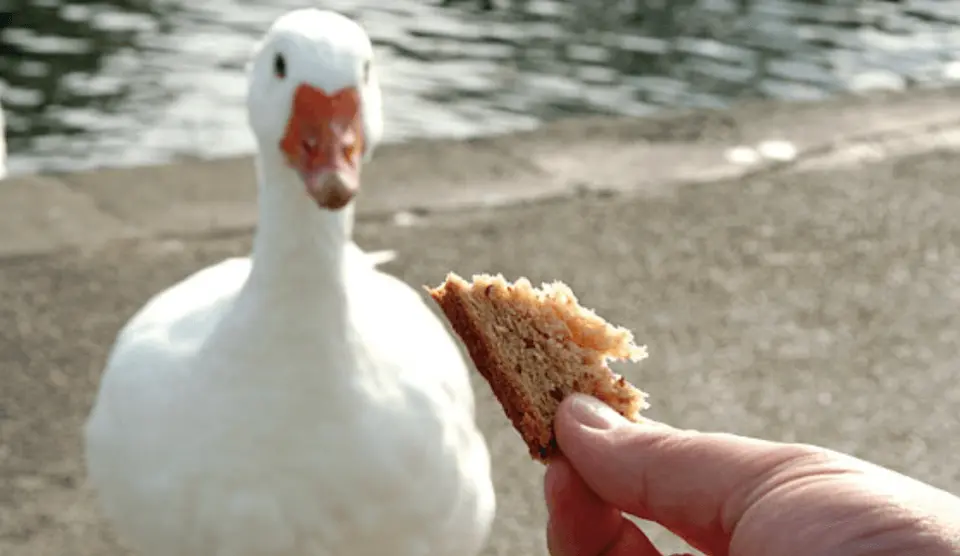
- Bread may be placed on the ground for animals to eat it (of course, in a place where there is no concern that it will be trampled).
- If there is concern about contamination (germs), the bread need not be picked up. Moreover, even if there is no danger of contamination, Rav Elyashiv holds that this bread need not be picked up, since people will no longer eat it.
(Rav Reuven Kuklin)