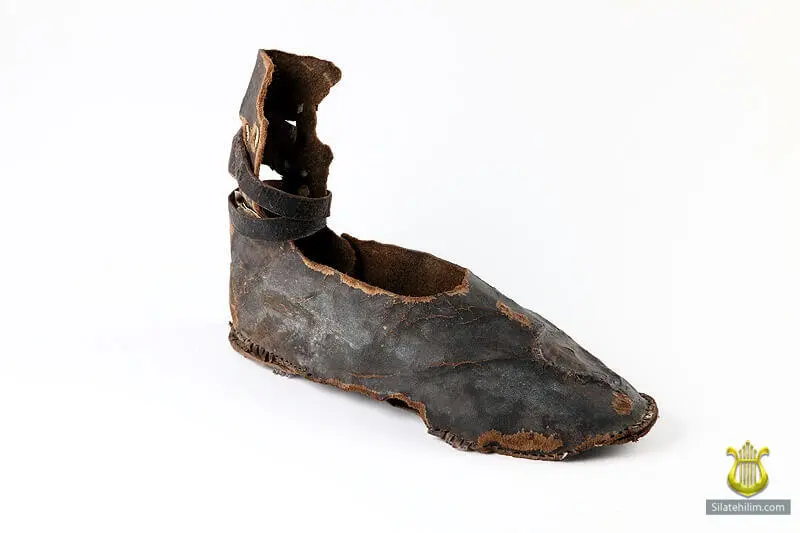
Shoes—the Jewish prohibitions of our grandmothers
Many Jewish sources write about the special significance of shoes. The Talmud states: “A person should sell the roof of his house in order to buy shoes for himself.”
Rabbi Akiva taught his son Yeshua never to walk barefoot. Kabbalists describe our body as a “shoe for the soul”. Just as a shoe protects the foot from dirt, our soul needs protection throughout its earthly life.
The Torah mentions na'alaim —sandals several times. They had wooden or leather soles and were tied around the calf with laces, cords, or straps. In the “Song of Songs” it says: “How beautiful are your feet in sandals...”
Walking barefoot was considered improper, but at certain times wearing shoes was prohibited. Thus, upon entering the Jerusalem Temple, in order to avoid bringing impurity inside, everyone was required to remove their shoes—the priests served barefoot. In Talmudic times, one had to remove one's shoes upon ascending the Temple Mount. Those who had been placed under a cherem—excommunication—walked barefoot or in special footwear. A scholar and Talmudic authority was forbidden to walk in patched shoes.
To this day, a tradition exists among Hasidim of removing one's shoes when visiting the graves of tzadikim. This tradition is explained by the words from the book of “Shemot”, which Moshe heard when G-d appeared to him from the burning bush: “Remove your shoes, for the ground on which you stand is holy.”
Leather shoes are considered in Jewish tradition a sign of prosperity, physical comfort, and sensual pleasure. Therefore, on Tisha B'Av, the day of mourning for the destruction of the JerusalemTemple, as well as on Yom Kippur, wearing leather shoes is forbidden. In addition, shoes made of genuine leather are not worn on days of mourning and fasting because they recall humanity's unintentional sin—the killing of and infliction of suffering upon animals.
Chalitzah
Of all the Jewish traditions associated with shoes, the most unusual is called “chalitzah”.
The book of “Devarim” says that if a married man dies childless, leaving an unmarried brother, the brother must marry the widowed sister-in-law in order to “restore” the deceased man's name. We find a reference to this custom in “Megillat Ruth”. Naomi tells her daughter-in-law Ruth that she should go to the threshing floor at night, lie beside Boaz, and remove his shoe.
However, the deceased man's brother may release his sister-in-law so that she can marry someone else.
This ceremony, which was considered highly humiliating for the man, is called “chalitzah.”
The widow and the deceased man's brother would appear before the Jewish court, the Beit Din. The deceased man's brother would place on his right foot a so-called chalitzah shoe. This special footwear was made from the leather of a kosher animal and consisted of two parts joined by a leather strap. The man would extend his foot wearing the laced shoe. The widow would declare that her deceased husband's brother refused to marry her, and he would confirm this. The widow would then bend down, untie the shoe's laces with her right hand, remove it from the man's foot, and throw it over her shoulder. She would then spit on the floor and recite in Hebrew: “So shall be done to the man who will not build up his brother's house, and his name shall be called in Israel: the house of the one whose shoe was removed.” The words “the house of the one whose shoe was removed” were repeated three times by everyone present. The judges would then recite the formula releasing the deceased man's brother from the obligation to marry the widow.
Thus, the most ordinary item—shoes—is associated in Jewish tradition with holiness and piety, with expressions of mourning and with condemnation.
Do not sleep in shoes
The Talmud (Yoma 78b) states that one who sleeps in shoes thereby experiences a taste of death. Therefore, it is forbidden to sleep in shoes. Some say that this also leads to forgetfulness. This applies only to shoes, not socks. The prohibition applies equally to men and women.
Do not polish shoes before a journey
Rabbi Yehuda HaHasid advised people not to polish their shoes on the day they planned to set out on a journey. The great Baal Shem Tov remarked that it was hard to believe that a mortal could have grasped such a thing (because he knew that this advice had a Kabbalistic explanation).
Barefoot
The priests served in the Temple barefoot—otherwise their service was not considered valid. When the kohanim were cold, they would go to warm themselves in a special room where there was a fire. (Tamid 1:1; see also Rashi, Shabbat 19b)
It is important to put on shoes in the proper order
The Talmud, in tractate Shabbat (61a), and the Shulchan Aruch (Orach Chaim 2:4), state: “One should put on the right shoe first, but not lace it; then put on the left shoe and lace it, and afterward lace the right one.”
Mishnah Berurah explains why this should be done in precisely this order: the right shoe is put on first because throughout the Torah we see that the right side is more significant than the left. And why is the left shoe laced first? Because when it comes to tying, the Torah gives precedence to the left side: after all, tefillin are placed specifically on the left arm.
(Based on material by Marina Agranovskaya, Rav Reuven Kuklin, and Rav Shaul-Isaac Andruschak)