The Prayer of King Hezekiah—the World's First Prayer for Healing
King Hezekiah reigned during the era of the First Temple and was regarded by many sages as Melech HaMashiach.
King Hezekiah's Connection to Healing
“King Hezekiah performed six important deeds,” says the Talmud (Pesachim 56a).
For three of them he earned the sages' approval, while for the other three he was censured.
King Hezekiah was commended for three actions, two of which were connected with healing.
1) He had his father's bones dragged through the city on a bed made of ropes, as a lesson to sinners—for Hezekiah's father, King Ahaz, was a wicked king;
2) He destroyed the copper serpent made by Moses our Teacher in the wilderness: “And the L-rd said to Moses: Make yourself a fiery serpent and place it on a pole. And it shall be that anyone who has been bitten, when he looks at it, will live. And Moses made a copper serpent and placed it on a pole. And so it was: if a serpent bit a person, and he looked at the copper serpent, he lived” (Numbers 21:8–9).
During the reign of King Hezekiah, people began worshipping this copper serpent, attributing miraculous powers to it and regarding it as some kind of “autonomous force” capable of influencing their fate. They forgot that the copper serpent on the tall pole was merely a tool through which they could be saved after committing a transgression by raising their eyes heavenward—that is, by turning to the L-rd. King Hezekiah destroyed the copper serpent in order to remove idolatry from the people of Israel;
3) He hid the “Book of Healing.”
When Noah was sailing through the waters in the ark he had built, he encountered a serious problem: both the people and the animals began to fall ill. Since there were only two of each person and animal in the ark, the spread of disease threatened their extinction. Therefore, the angel responsible in the higher spiritual realms for healing the creatures of the earth, acting on the “instruction” of the L-rd, wrote detailed instructions for curing every illness and gave these records to Noah. This enabled Noah to successfully treat both animals and people. This was the “Book of Healing.” Even later, when humanity had multiplied to such an extent that disease no longer threatened to wipe it from the face of the earth, people continued using this miraculous book and were cured of every illness.
When King Hezekiah saw that people no longer viewed illness as something connected with Heaven and had forgotten Who had established the laws and given them the means of healing, he hid the miraculous book.
He knew that every organ of the human body is connected with a particular mitzvah. Failure to observe a given mitzvah could bring about illness, while fulfilling a mitzvah could bring healing. He therefore decided that changes in a person's physical condition should take place through natural means.
The Story Behind the Prayer of King Hezekiah and Its Connection to the Plague
He cleansed Israel of idols and stood against the Assyrian king Sennacherib, who invaded the country and sent King Hezekiah a message: “Just as the idols could not protect the nations that worshipped them when the king of Assyria waged war against them, so too the L-rd will not save His people from the mighty Assyrian army.”
That day, the entire nation tore their garments as a sign of mourning, while King Hezekiah and his attendants covered themselves with sackcloth and began pleading with the L-rd for help.
The prophet Isaiah—King Hezekiah's uncle—urged him not to listen to Sennacherib and to trust in Hashem.
The enormous Assyrian army encamped outside the walls of Jerusalem late in the evening, on the eve of Passover. Sennacherib planned to attack in the morning, but suddenly, during the night, for a reason that remains unknown to this day (an epidemic?), 185,000 men in the Assyrian army died. Thus the L-rd answered the prayer of King Hezekiah and his subjects.
Sennacherib returned home with the remnants of his army, telling everyone of his victory.
The prophet Isaiah told the king that the Creator must be thanked for the deliverance by reciting Hallel publicly: “Sing to Him, for He has done great things.” (Isaiah 12:5)
But Hezekiah did not proclaim Hallel HaGadol. As the sages of the Talmud say, this is why he did not become Mashiach, although he had every chance of doing so (Sanhedrin 94a).
The prophet Isaiah foretold the gravely ill king that he would “die and not live.” “He will die” refers to physical death, while “he will not live” means that he would lose eternal life. Hezekiah did not understand this, since he had been a righteous king throughout his life. The prophet explained that he had failed to fulfill one of the principal mitzvot: “Be fruitful and multiply.” King Hezekiah replied that he had failed to do so because he had foreseen through prophecy that a wicked son would be born to him. Thus, his intentions had been entirely pure.
The prophet told him: “It is not your concern to reason about what will happen. This is G-d's world. He said what must be done, and it must be done. There is a mitzvah, and it must be fulfilled.” King Hezekiah replied to the prophet: “I understand my mistake. You have a daughter; give her to me as a wife. Perhaps your merits and mine together can somehow rectify the situation.” The prophet answered that it was too late—the decree had already been issued: King Hezekiah would die and would not live.
The king insisted: “You do not have the full picture. For I received a tradition from the house of my father, King David: even if a sharp sword is already resting upon your neck, do not despair, do not give up hope; trust in G-d's mercy.”
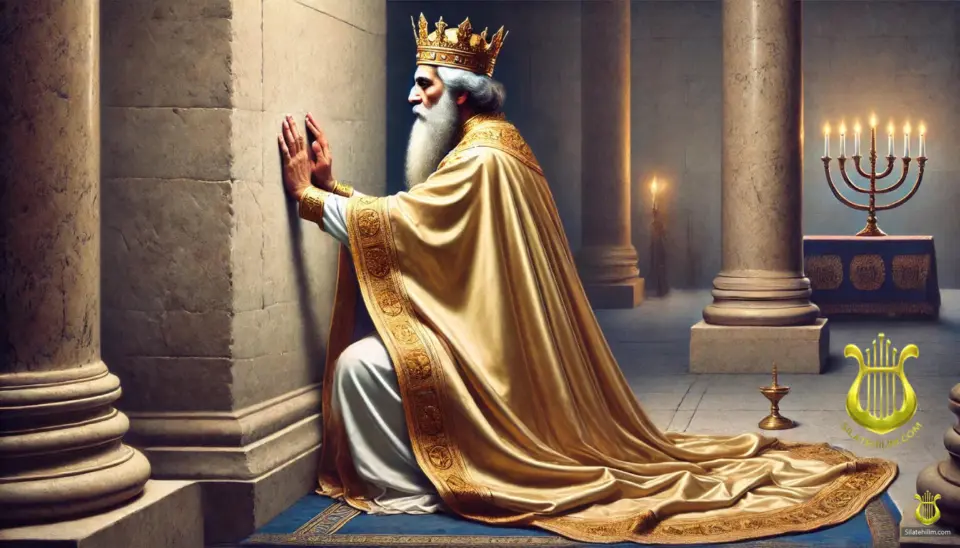
King Hezekiah turned toward the wall and began to weep and pray (it is from here that Jews learn the practice of hitbodedut).
The L-rd forgave King Hezekiah, and he once again found favor in the eyes of the Creator. He married the daughter of Isaiah, his uncle, and they had a son—the future king Manasseh, whose later conduct King Hezekiah had foreseen.
As a sign of this miracle—the healing of King Hezekiah—the shadow on the sundial moved backward by ten steps (II Kings 20:1–11).
King Hezekiah—the First Person Who, Upon Falling Ill, Asked the L-rd for Healing and Was Cured Through Teshuvah
Following this episode, Chazal established that whenever someone is ill or undergoing issurim (suffering), he should repeat the prayer recited by King Hezekiah.
It brings salvation from all harsh Divine decrees and can halt them even after the decree has already been issued Above.
King Hezekiah reigned for 14 years and was afflicted with a fatal illness, but after repenting he was healed and reigned for another 15 years—longer than he had ruled before his illness.
After Hezekiah's death, according to Rabbi Yehuda, 36,000 people followed the king's bier with their shoulders bare as a sign of mourning; according to Rabbi Nehemiah, a Torah scroll was placed upon his bier with the words: “This man fulfilled everything written in this scroll”:
The History of the Prayer
בַּיָּמִים הָהֵם חָלָה חִזְקִיָּהוּ לָמוּת וַיָּבוֹא אֵלָיו יְשַׁעְיָהוּ בֶן אָמוֹץ הַנָּבִיא וַיֹּאמֶר אֵלָיו כֹּה אָמַר יְהוָה צַו לְבֵיתֶךָ כִּי מֵת אַתָּה וְלֹא תִחְיֶה:
“Ba-yamim ha-hem chalah Hizkiyahu lamut va-yavo elav Yeshayahu ben Amotz ha-navi va-yomer elav: Ko amar Adonai, tzav le-veitecha ki met atah ve-lo tichye.”
(In those days Hezekiah fell mortally ill, and the prophet Isaiah, son of Amoz, came to him and said: Thus said the L-rd: Set your house in order, for you will die and not recover.)
וַיַּסֵּב חִזְקִיָּהוּ פָּנָיו אֶל הַקִּיר וַיִּתְפַּלֵּל אֶל יְהוָה: וַיֹּאמַר אָנָּה יְהוָה זְכָר נָא אֵת אֲשֶׁר הִתְהַלַּכְתִּי לְפָנֶיךָ בֶּאֱמֶת וּבְלֵב שָׁלֵם וְהַטּוֹב בְּעֵינֶיךָ עָשִׂיתִי וַיֵּבְךְּ חִזְקִיָּהוּ בְּכִי גָדוֹל:
“Vayasev et panav el ha-kir va-yitpalel el Adonai le-emor. Ana Adonai, zechor na et asher hitalachti lefanecha be-emet u-ve-levav shalem ve-ha-tov be-einecha asiti, va-yevke Hizkiyahu bechi gadol.”
(And Hezekiah turned his face to the wall and prayed to the L-rd. (3) And he said: “Please, O L-rd! Remember, please, how I have walked before You faithfully and with a whole heart, and have done what is good in Your eyes.” And Hezekiah wept bitterly.)
[King Hezekiah Is Forgiven]
(4) And the word of the L-rd came to Isaiah, saying: (5) Go and say to Hezekiah: Thus said the L-rd, the G-d of David your father: I have heard your prayer; I have seen your tears. Behold, I will add fifteen years to your days. (6) And I will save you and this city from the hand of the king of Assyria, and I will protect this city. (7) And this shall be the sign for you from the L-rd that the L-rd will do this thing which He has spoken. (8) Behold, I will cause the shadow on the steps, which has descended on the steps of Ahaz's sundial, to go backward ten steps. And the sun went backward ten steps on the steps by which it had descended.
Segulot Associated with the Prayer of King Hezekiah
1. In “Tefillot HaMaharal,” quoting Rashi, it is written that one should recite the Prayer of Hezekiah, which he received from Shamayim. This is recorded in Isaiah (38:9–20). It was revealed to him that a sick person or someone undergoing trials should read it and be saved from all harsh judgments.
1. Recite it throughout the month of Iyar, the month of healing (Yeshivat Kise Rachamim).
2. Sefer “Ta'amei HaMinhagim” (p. 319) mentions this segulah for salvation.
3. “Vovey HaAmudim” writes that it is desirable to read this prayer with tears.
The Prayer of King Hezekiah
The Prayer of King Hezekiah
(Rabbi Meir Mazuz, Yeshivat Kise Rachamim, with thanks to Yura Plishtiev)
Was this helpful?
96% of readers found this article helpful (90 votes).
Please note: some articles on our site contain the holy Names of the Almighty. If you print these articles, they may not be thrown away or destroyed. Please handle printed copies with care and respect.