
May Jews Whistle? Jewish Prohibitions from Our Grandmothers
May Jews Whistle? Jewish Prohibitions from Our Grandmothers
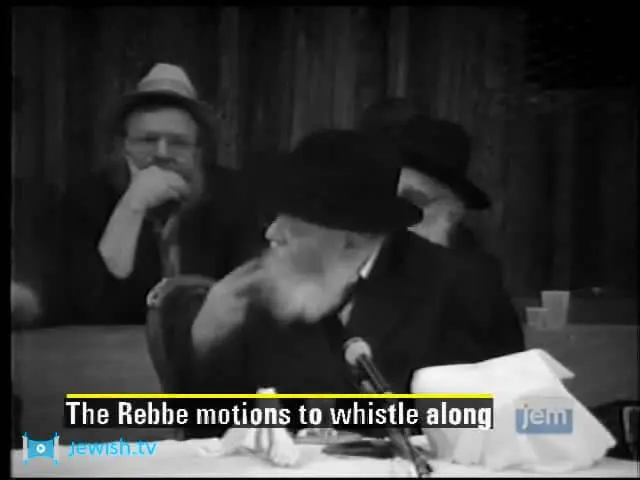
In 5736, during a Farbrengen in honor of Rosh Chodesh of the month of Cheshvan (October 1975), the Lubavitcher Rebbe suddenly turned to those gathered in the midst of a song and made a whistling gesture with his fingers.
Many Chassidim immediately began to whistle, and an atmosphere of joy filled “Seven Seventy.”
Several months later, at a Farbrengen in honor of Purim, the Rebbe responded to all the questions raised by his action, explaining that there was nothing improper about what he had done, and that descriptions of similar conduct can be found as far back as the books of the Prophets.
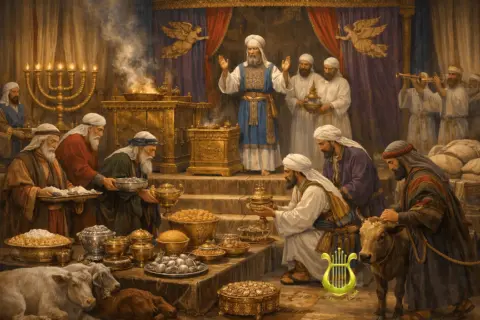
Thus, the Book of II Samuel tells how King David brought the Ark of the Covenant with the Tablets to Jerusalem. Everything took place much as it does today when a Torah scroll is brought into a synagogue. A large procession accompanied the Ark, and naturally, King David led the procession:
“And it was so, when the bearers of the Ark of G-d had taken six steps, he sacrificed a bull and a ram. And David danced with all his might before the L-rd; and David was girded with a linen ephod. Thus David and all the House of Israel brought up the Ark of the L-rd with shouts (whistles) and to the sound of the shofar.” (II Samuel, 6:13–16).
David danced as Jews dance on Simchat Torah. Moreover, his conduct went beyond what was considered appropriate for a king in the presence of his subjects. Overwhelmed with joy, David leaped like a Chassid, not like a king.
Michal, the daughter of Saul and David’s wife, stood at the window and watched the procession and David’s wild behavior, which she strongly disapproved of:
“And when David returned to bless his household, Michal, the daughter of Saul, came out to meet David and said: ‘How honored was the king of Israel today, when he exposed himself today before the eyes of the maidservants of his servants, as one of the vulgar fellows might expose himself!’” (II Samuel, 6:20)
The Tanakh continues: “And David said to Michal: ‘Before the L-rd, Who chose me over your father and over all his household, appointing me ruler over the people of the L-rd, over Israel, I will rejoice. And I will humble myself still more, and I will be lowly in my own eyes, but among the maidservants of whom you have spoken, among them I will be honored.’” (II Samuel, 6:21–22).
The Midrash explains: “David said to her: ‘In your father’s house, they did not show honor to Heaven, but were concerned with being treated honorably themselves. But I do not concern myself with my own honor; I care only about honoring the Creator. The fact that I danced before the L-rd is counted to my credit, and that is why the Almighty chose me rather than your father. And He deemed it fitting that I humble myself before Him, and I was humbled in His eyes in every way; but to me this is not shame—it is honor.’”
(Rabbi Avraham Wolff — Chief Rabbi of Odessa and Southern Ukraine)
The idea behind the whistling encouraged by the Rebbe is to awaken the Jewish spark within a person during a moment of joy, helping a Jew experience the fullness of joy in a mitzvah and while performing a mitzvah.
The Rebbe pointed to several sources in the Torah that refer to whistling during the joy of fulfilling a commandment:
“And it shall be on that day: G-d will whistle for the fly that is at the farthest end of the channels of Egypt, and for the bee that is in the land of Assyria.” (Isaiah 7:8)
“I will whistle for them, like a shepherd, and gather them, for I have redeemed them…” (Zechariah 10:8)
The Talmud emphasizes that the prophet is referring to whistling in the literal sense.
(Talmud, tractate Chullin 63a)
As we can see, the word “whistle” is mentioned in the Prophets in connection with Hashem Himself, and therefore comes from the side of holiness.
It is clear that Jewish sources speak of whistling only in connection with the joy of a mitzvah, which has its source in holiness—not of whistling associated with wild and uninhibited behavior, which comes from the side of impurity.
(Rabbi Avi Gedj)
Was this helpful?
90% of readers found this article helpful (21 votes).
Please note: some articles on our site contain the holy Names of the Almighty. If you print these articles, they may not be thrown away or destroyed. Please handle printed copies with care and respect.
Tags: Segulot, Our Grandmothers’ Jewish Prohibitions, Lubavitcher Rebbe, Are Jews Allowed to Whistle? , Whistling