Tehillim and the Levites
Tehillim and the Levites
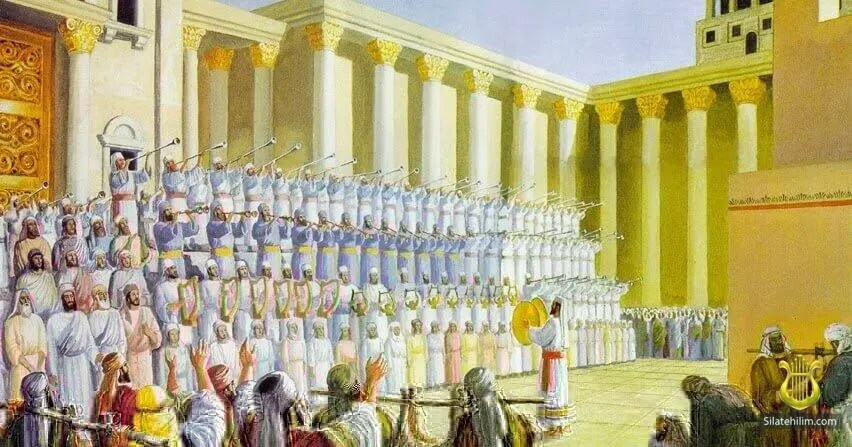
The Levites belonging to the family of Gershon were required to sing during the daily morning and afternoon offerings, as well as during all communal olot offerings and the communal shalmei offerings on the holiday of Shavuot.
The Levitical choir had to include at least 12 singers, and preferably more; they sang accompanied by musical instruments. The musicians did not necessarily have to be Levites.
Standing in the courtyard, the people could hear the orchestra and the Levitical choir.
In the Temple, on each day of the week, the choir sang a particular chapter from the book of Tehillim.
On the first day of the week — "The earth is Hashem's and all that fills it, the world and all who dwell in it" (Tehillim 24:1).
This verse was especially appropriate for the first day of the week, for it reminds us of the first day of Creation. On that day, Hashem could not but be recognized as the sole Ruler, for no one else yet existed—even the angels had not yet been created.
On the second day — "Great is Hashem and exceedingly praised in the city of our G-d, on His holy mountain" (Tehillim 48:2).
On the second day of Creation, Hashem established the firmament to divide the upper waters from the lower waters and designated the upper realms as His dwelling place. In keeping with this, He ordained a place of special holiness in the lower world where He would dwell—"the city of our G-d, His holy mountain."
On the third day — "G-d stands in the congregation of judges" (Tehillim 82:1).
On this day, G-d gathered the waters into the seas, thereby drying the continents that would later be inhabited by people. But people were permitted to live there only on condition that they practice justice—one of the pillars upon which humanity is founded. If people pervert justice, Hashem will command the seas to inundate the land, as later happened to the people of the Generation of the Flood.
On the fourth day — "G-d of vengeance, Hashem, G-d of vengeance, appear!" (Tehillim 94:1).
On this day, the heavenly bodies were created. In the future, Hashem will punish all those who worshipped them.
On the fifth day — "Sing joyfully to G-d, our Strength; shout triumphantly to the G-d of Yaakov" (Tehillim 81:2).
On that day, the Almighty created millions of species of birds and fish. Anyone who beholds them joyfully proclaims praise to the Creator.
On the sixth day — "Hashem reigns; He is clothed in majesty; Hashem is clothed in strength and girded" (Tehillim 93:1)
This verse is appropriate for the sixth day, the day on which the magnificent Creation was completed, when Hashem's majesty shone clearly over the entire universe.
On Shabbat — "A psalm, a song for the Sabbath day" (Tehillim 92:1).
This verse refers not only to the Shabbat that comes every week, but also to the era that will follow the Redemption—"the great Shabbat in the history of humankind."
The weekly Shabbat was given to us as a model for the coming era, an era of infinite and eternal goodness. Just as we work throughout the week to honor Shabbat with delicacies, so we prepare ourselves in this world for the World to Come, when we will enjoy the fruit of our labors.
With the destruction of the Temple, the beauty of all these songs disappeared. Our songs today do not possess the holiness or the harmony of spiritual perfection inherent in the hymns sung in the Temple.
After the destruction of the First Temple, the emperor Nebuchadnezzar led a group of captive Levites to Babylonia. Seeing them weeping and lamenting, he exclaimed: "Why are you so sad? Come on, let's have some fun! Before I begin my meal, play for me and my gods on your kinorot, as you used to play for your G-d!"
Exchanging glances, the Levites whispered to one another: "Never! We who played in the Temple for the Almighty—are we now going to play for this dwarf (Nebuchadnezzar was short) and his idols?! If only we had sung for the Almighty with greater devotion, we would never have ended up in exile!"
A plan immediately emerged. Without hesitation, each Levite cut off the thumb of his right hand. Raising their bleeding stumps so that Nebuchadnezzar would see them, they cried out: "How can we sing the song of Hashem"? (Tehillim 137:4). "Can't you see that our hands are maimed and we can no longer play musical instruments?"
Enraged, Nebuchadnezzar ordered thousands of captives to be put to death. But the Levites did not regret refusing to play before the idols.
Eventually, this group of Levites returned from the Babylonian exile and witnessed the construction of the Second Temple. Hashem solemnly promised the Jewish people: "For My sake, the Levites maimed their right hands; therefore I swear by My right hand that ultimately I will vanquish your enemies and return Jerusalem to you."
(Rabbi Moshe Weissman, "The Midrash Says")
Was this helpful?
91% of readers found this article helpful (11 votes).
Please note: some articles on our site contain the holy Names of the Almighty. If you print these articles, they may not be thrown away or destroyed. Please handle printed copies with care and respect.
Tags: The Power of Tehillim, Levites, The Levites’ Song, Tehillim in the Temple