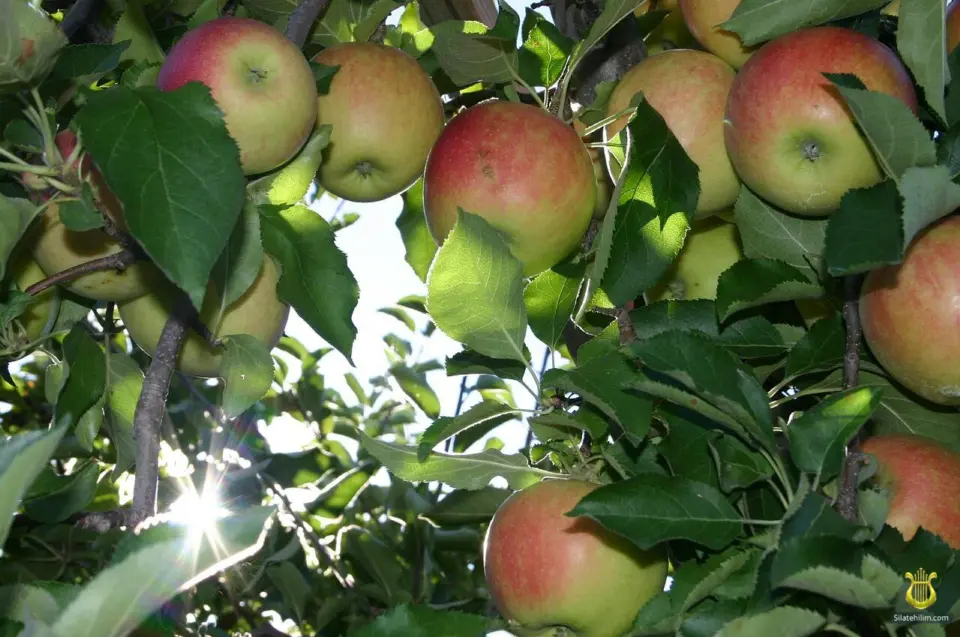
\r\nEating an apple at the Shabbat meal is a beautiful Kabbalistic segula mentioned in several holy sources, beneficial both for material abundance and for longevity and good health.\r\n\r\nChiddushei HaRim (the founder of Gur Hasidism) cites the Maggid of Kozhnitz (a disciple of the great Maggid of Mezhirech) as saying that one should eat an apple during the first Shabbat meal. Eating an apple on Saturday night is said to bring abundance and prosperity throughout the week (apple juice may also be used).\r\n\r\nIn the book Kaf HaChaim, Rabbi Yaakov Chaim Sofer writes that eating an apple on Shabbat is a segula for obtaining a livelihood and corresponds to חקל תפוחין קדישין—“Hakel Tapuchin Kadishin”. These Aramaic words come from Atkinu Seudata, the introduction written by the Arizal HaKadosh (may his merit protect us) to the three Kabbalistic Shabbat hymns.\r\n\r\n- “Atkinu seudata di-meheimnuta sheleimta, chedvata de-Malka Kadisha. Atkinu seudata de-Malka. Da hi seudata de-Hakel Tapuchin Kadishin.”\r\n\r\n(Prepare the meal in honor of perfect faith—the joy of the Holy King. Prepare the meal in honor of the King. This is the meal of the “holy apple orchard.”)\r\n\r\nIn the book Chayei Bni u-Mazoni, in the section on Shabbat in Tosafot, it is written: “The apple is an etrog, and the fruit of the Tree of Knowledge was an etrog, as cited in Sha'ar HaKavanot regarding the fruit that Adam HaRishon tasted on Erev Shabbat. But had he eaten it after Shabbat had already begun, he would not have been punished with the words: ‘By the sweat of your brow you shall eat bread.’\r\n\r\nIf so, the Maggid of Kozhnitz saw in this a rectification of the punishment and a segula for a good livelihood.\r\n\r\nIt is also written that a hint regarding the root of parnassah is contained in the verse from Tehillim (145:16) פותח את ידך—“pote'ach et yadekha” (You open Your hand), and the word for apple—תפוח—is made up of the same letters as פותח (opens). Shabbat is the source from which blessing is revealed, and in particular, of the first tasting of fruit (the first thing that man tasted in this world was the fruit of a tree).\r\n\r\nWhat color apple is preferable to eat?\r\n\r\nAn apple of three colors.\r\n\r\nIt is stated in the holy Zohar: Rabbi Chiya said, “Like an apple tree among the trees of the forest, so is my beloved among the sons”—meaning that the apple is described as the most distinguished of all fruits. What makes it distinguished, asks the holy Zohar?\r\n\r\nIts fragrance, color, and taste.\r\n\r\nJust as an apple is a remedy for all illnesses, so is G-d the Healer of all illnesses.\r\n\r\nJust as an apple has three colors—white, red, and yellow-green—so does the Holy One, blessed be He, manifest Himself through three Supernal Colors: white—Chesed, red—Gevurah, and yellow-green—Tiferet.\r\n\r\nJust as an apple has a fragrance—its fragrance is subtler than that of all other fruits—so too does G-d have a fragrance, as it says in Shir HaShirim: “And the fragrance of Him is like the fragrance of Lebanon.”\r\n\r\nJust as an apple has a delicate, sweet taste, so too does G-d have a taste—and He gives flavor to our lives, sweetening our lives.\r\n\r\nThus, according to the holy Zohar, an apple should have three colors: red, white, and yellow-green;\r\n\r\nThe apple should be sweet, not sour;\r\n\r\nThe apple should have a fragrance—as the Maharal of Prague explains, the fragrance of an apple is the fragrance of Gan Eden.\r\n\r\nMoreover, all three colors correspond to the three Patriarchs.\r\n\r\n \r\n\r\n(Compiled by the editorial staff from holy Jewish sources)
Source:(«https://www.hidabroot.org/magazine/article_amp/227304 - переведено редакцией сайта при содействии Александра Цви Сыпкова)
Was this helpful?
99% of readers found this article helpful (111 votes).
Please note: some articles on our site contain the holy Names of the Almighty. If you print these articles, they may not be thrown away or destroyed. Please handle printed copies with care and respect.
Material from our site may be copied for the purpose of spreading Torah, provided a link to Silatehilim.com is included. Any use of the site's material in print publications or for commercial purposes is prohibited without the rights holder's consent.