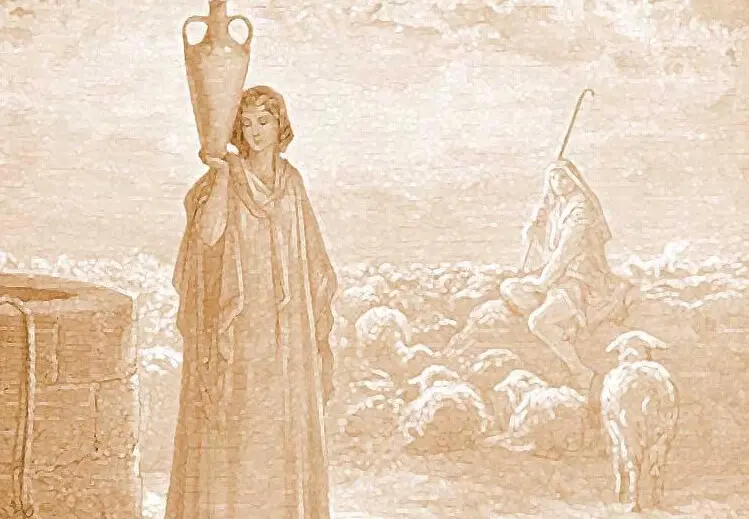
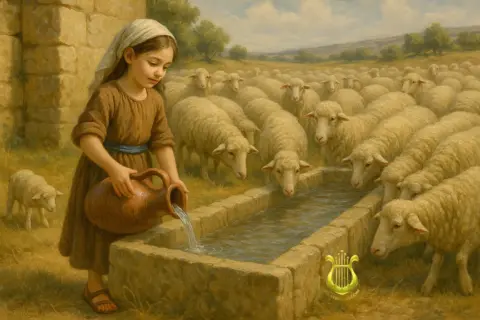
- “While he was still speaking with them, Rachel came with the sheep belonging to her father, for she was a shepherdess” - (Bereishit 29:9)
This verse contains 12 words and 41 letters. The 12 words allude to the 12 Tribes, while 41 represents the word “Em” — mother.
From this verse, the Sages teach us that Rachel Imeinu is considered the mother of the 12 Tribes of Israel.
The third word in this verse is the 52nd Name of G-d — עמם. It contains the word “am” (nation), which can be rendered as “the Nation of Chesed,” since in the word “mother,” the letter mem symbolizes water, which, according to Kabbalah, is the essence of Chesed.
Rachel was born in Haran in the year 2170. Jacob was born in 2130, and was 40 years old when Rachel was born.
As is well known, 40 is a significant number in Kabbalah — a symbol of purification and transformation.
- “Va-yizkor Elokim et Rachel va-yishma Elokim eileha va-yiftach et rachmah” - (And G-d remembered Rachel, and G-d heard her, and He opened her womb) (Bereishit 30:22)
This verse contains 10 words and 40 letters. Ten signifies completion and creation, and also symbolizes the ten sefirot. Forty represents the energy of Rachamim. The final word — Rachamah — is related to the word rechem (womb). Therefore, the Name Elokim appears twice in this verse, hinting that she would have two righteous sons — Joseph and Benjamin.
Rachel was buried by the roadside because she is the chariot of Malchut in Jacob/Israel, her husband, who is Zeir Anpin, while Leah, her sister, is the chariot of Binah.
Rachel was renowned for her beauty. (Bereishit Rabbah 70:16)
Joseph’s beauty was reminiscent of Rachel’s. (Zohar 1:116b)
Rachel and Leah were twins, and they were both 22 years old when Jacob came to their home. (Seder Olam Rabbah 74:4)
The Torah says of Rachel: “And Rachel was barren (akarah)”.
Rabbi Isaac said: “Rachel was the foundation (ikaro) of the household,” for it is written, “and Rachel was barren” — read it as “the foundation of the household.” (Bereishit Rabbah 71:1)
Why did Rachel die first?
- Because of Jacob’s curse, when he said: “Whoever has your gods shall not live”; (Bereishit 31:32)
- Because she spoke before her older sister, as it is written: “Then Rachel and Leah answered and said to him”; (Bereishit 31:14, Bereishit Rabbah 74:4)
- Because Jacob delayed fulfilling the vow he had made before G-d (in Bereishit 28:20–22), the power of Jacob’s accuser was strengthened. Therefore, Rachel experienced difficulty in childbirth. (Zohar 1:175a)
She died at the age of 36 (Seder Olam Rabbah 2, the Vilna Gaon). Incidentally, this is the gematria of the name Leah.
Rachel said: “For this, let him be with you tonight”. (Bereishit 30:15) By giving up her night with Jacob, Rachel forfeited the right to be buried together with him. (Bereishit Rabbah 72:3)
The Zohar explains that Leah would go out to the crossroads every day, weeping and praying to marry Jacob, whose righteousness she had heard about, instead of the wicked Esau.
Rachel, however, did not go out to the road and did not pray. Therefore, Leah merited being buried beside Jacob, while Rachel’s grave stands at the crossroads. (Zohar 1:223a)
She was buried in Beit Lechem, where many Jews have visited her grave throughout the past thousands of years.
The place of her burial will not disappear until the day when the Holy One, blessed be He, resurrects the dead. (Zohar 1:175a)
The Haftarah for Rosh Hashanah consists of the words of the prophet Jeremiah about Rachel weeping for her children (the people of Israel).
In Kabbalah, we learn that the 12 months of the Jewish year have two heads, or “parents” — the months of Nissan and Tishrei. The month of Nissan is the “father” of all the months of the year, while the month of Tishrei is the “mother” of all the months of the year. In Kabbalah, the shofar of Rosh Hashanah symbolizes the mother’s womb; its blasts represent the birth of a new (blessed) year.
The gematria of Rosh Hashanah = רֹאשׁ הַשָׁנָה – 861 — which is also the sum of all the integers from 1 to 41.
41 is the gematria of “mother,” אֵם.
11 Cheshvan is the 41st day from Rosh Hashanah.
Our Sages teach us that “The Gates of Tears are never closed.” In the midnight prayer of Tikkun Chatzot, in the “Tikkun Rachel”, one has the kavanah that the name “Rachel” (רָחֵל) equals 238 = 2 ∙ 119; 119 is the gematria of the Hebrew word for “tear,” (דִמְעָה).
(Translation by Sila Tehillim, based on the works of Rabbi Avraham Sutton and the Tzadikim website)
Was this helpful?
98% of readers found this article helpful (42 votes).
Please note: some articles on our site contain the holy Names of the Almighty. If you print these articles, they may not be thrown away or destroyed. Please handle printed copies with care and respect.
Material from our site may be copied for the purpose of spreading Torah, provided a link to Silatehilim.com is included. Any use of the site's material in print publications or for commercial purposes is prohibited without the rights holder's consent.