Jewish Alchemy or Refuah Shleimah through Gold, Silver, and Copper
Jewish Alchemy or Refuah Shleimah through Gold, Silver, and Copper
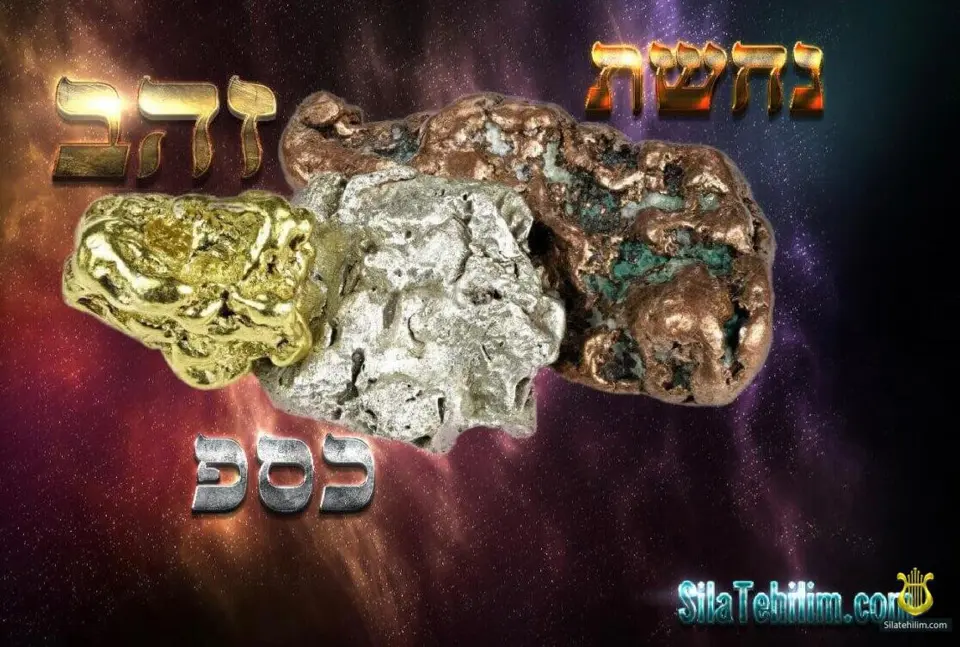
During the construction of the Temple and the transportable sanctuary, the Mishkan, three primary metals were used—gold, silver, and copper:
— “And this is the contribution that you shall take from them: gold, silver, and copper.”(Exodus 25:3)
Many of the great Torah sages, (including the Rosh, “Iggeret ha-Tiyul”—the brother of the Maharal of Prague, “Torah LeShmah,” and “Esa Einai”), in commenting on this pasuk, explain the inner meaning of the expression in which the three metals—gold, silver, and copper—are identified with three levels of a person’s health (or illness), and with three levels of charity—tzedakah, the mitzvah through which a sick person appeals to Divine mercy in order to be healed.
The name of each metal is deciphered as an acronym:
— Gold— זהב — זה הנותן בריא“zahav—zeh ha-noten bari”— (gold—the one who gives is healthy);— Silver —כספ — כשיש סכנת פחד“kesef—k’she-yesh sakanat pachad”— (silver—when danger threatens);— Copper— נחשת — נתינת חולה שאמר תנו“nechoshet—netinat choleh she-amar tnu”— (copper—the gift of a sick person who says: Give.)“The one who gives gold” rectifies the soul’s three behavioral qualities (Netzach—Hod—Yesod), healing those illnesses associated with the corresponding physiological systems in the body.
Such actions involve good deeds and loving-kindness, which, according to the sages, are the primary fruits of a person’s life (Netzach—Hod—Yesod)—these are the soul’s “children.”
A person’s children, both in the physical sense (actual children, as well as students and those who have drawn close to Torah learning) and in the spiritual sense (mitzvot and good deeds), are a person’s true gold.
When a person constantly strives to “give gold”—doing everything in his power to help others—he will always be healthy (zahav—the one who gives is healthy).“Giving gold” is, in fact, a means of preventing all illnesses.
“The one who gives silver”—by doing so, rectifies the soul’s three emotional attributes (Chesed—Gevurah—Tiferet), healing those illnesses associated with the corresponding physiological systems in the body.
Positive emotions are silver—especially the feeling of love for one’s fellow, which, according to Kabbalah, is “silver.”
If a person is ill, this means that access to the “gold” (the ability to bring forth fruits through one’s actions) is limited, and at that moment he must devote himself to “giving silver.”
This means that he is not seriously ill. He should try to awaken love for other people in his heart and express it in his prayers.
The sages teach that when a person prays for his fellow, the Almighty answers him first and gives him what he himself needs. A person gives “silver” when he “stands in danger”—that is, when his health has deteriorated and illness awakens in his heart a fear of death. Positive emotions toward those around him create a positive atmosphere and thereby save him from the constant feeling that his life is under threat.
“The one who gives copper”—by doing so, rectifies the soul’s three intellectual powers (Chochmah—Binah—Da’at)and heals illnesses associated with the corresponding physiological systems.
Positive and healthy thoughts are “copper.”
When a person is ill, and even the strength needed to awaken emotions in his heart (silver) is absent, he must focus all his thoughts on the Almighty and on how He watches over all His creations. In his thoughts, a person gives his entire self to the Almighty, saying to everyone around him—in other words, addressing them sincerely and openly with the intention of encouraging them, too, to place themselves entirely in the Almighty’s hands: “Give [everything].”
As the Mishnah explains (Peah 3:7), the primary sign of a “bequest on one’s deathbed” is the transfer of allof a person’s possessions, without leaving anything behind.
“The one who gives copper” focuses all his attention on the bronze serpent that Moses made at the Almighty’s command. He gazes upward, toward the heavens, and perceives Divine Providence as the source of his illness—and therefore, ultimately, as being for his own benefit.
Through pure thoughts, a person elevates everything and returns it all to the Almighty. This act, more than anything else, awakens the Almighty’s great and boundless mercy toward him, and He miraculously sends him healing. The words “make yourself a serpent and place it on a pole (nes)” point to this “miraculous healing,” and Chazal explain that the word “nes,” although on the level of “pshat” it refers to a tall pole, also denotes the miracle that took place: “and he placed it on a ‘nes’ means that he threw it into the air, and it took its place on its pedestal by itself.”
Pure thoughts focused solely on G-d save a person from the madness threatened by the serpent’s venom.
(Rabbi Yitzchak Ginsburgh, “Body, Mind, and Soul”)
Was this helpful?
100% of readers found this article helpful (15 votes).
Please note: some articles on our site contain the holy Names of the Almighty. If you print these articles, they may not be thrown away or destroyed. Please handle printed copies with care and respect.
Material from our site may be copied for the purpose of spreading Torah, provided a link to Silatehilim.com is included. Any use of the site's material in print publications or for commercial purposes is prohibited without the rights holder's consent.