


1. The Almighty treats us as we treat Him.
Rabbi Chaim of Volozhin explains this principle of retribution for one's deeds by way of an analogy: “Just as the shadow of an object precisely repeats its movements, so the Creator, as it were, links the changes in all the worlds to a person's deeds on earth.” King David said the same thing: “G-d is your shadow.” (Tehillim 121:5)
It is like your reflection in a mirror: you smile at it, and it smiles at you; you cry, and it cries too; you look at it angrily, and it does the same. So too with G-d—He is “your shadow”: as you are with Him, so He is with you.” (“Nefesh HaChaim” 1:7)
2. One who always thanks the Almighty for everything will not need to pray because of troubles.
One who recites Psalm 100 (the psalm of thanksgiving) throughout his life will not come to need Psalm 20 (the psalm for times of trouble).
Psalm 100 is called the psalm of thanksgiving because of its opening words: “Mizmor LeTodah.”
Rabbi Elimelech Biderman explained the need to thank the Almighty throughout one's life as follows: The Torah says: “And the life of Sarah was one hundred years, and twenty years, and seven years.” (Bereishit 23:1)
Why are Sarah's years divided into one hundred, twenty, and seven?
Rashi writes that just as Sarah had no sins at the age of twenty, since Heaven does not judge a person before the age of twenty, so too she was free of sin at the age of one hundred. He also explains that at twenty Sarah was as beautiful as she had been at seven.
Rabbi Biderman sees in this division into one hundred and twenty a hint to another teaching, far removed from the plain meaning of the Torah itself: “One who recites Psalm 100 throughout his life will not come to need to recite Psalm 20!”
One who constantly carries Psalm 100 of thanksgiving to the Almighty in his heart will not need to sustain himself with the words of Psalm 20: “May the L-rd answer you on the day of trouble.”
3. One who makes a determined move toward the Almighty receives a flow of blessings.
The Ohr HaChaim says that the Torah states in Parashat Tazria: “If a woman conceives and gives birth...”
All the worlds created by the Almighty possess two natures: a masculine nature—the giving force—and a feminine nature—the receiving force.
In relation to the First Source, the Almighty, we Jews are the Receiving, “feminine,” side.
Every mitzvah we perform, every prayer we offer, and every Torah lesson we study is a movement toward G-d, which in turn brings a flow of blessing.
Sometimes we are able to make a determined move toward our Creator. At other times, we are in a deep sleep, and the Almighty must “shake” us in various ways so that we take a step toward Him and He can send us His blessing in return.
The Ohr HaChaim reveals that “if a woman conceives and gives birth to a son” means that if we ourselves take steps toward G-d, awakening ourselves through our own efforts, then “she gives birth to a son”—we receive the blessing that comes in response, and it is much more powerful.
4. “Mi-she-zakai lekabel yoter” In Judaism there is a spiritual principle: one who performs a mitzvah (commandment) or engages in gemilut chasadim (acts of kindness) beyond measure, beyond his own strength, and more than the law requires, receives in return more blessings than he is allotted in Heaven. 5. How can we know whether what we do is pleasing to the Almighty?Rabbi Pinchas of Koretz gives us an interesting indication. Torah and Divine service create a “garment” for a person's soul.
With the help of this garment, at night during sleep, the soul ascends to the Heavenly Temple and is brought as an offering upon the altar by Michael the High Priest.
If, upon awakening in the morning, a Jew feels inspired and eager to serve the Creator, that fire in the soul comes from the fire of the Heavenly altar where it had been.
But if during the day a person did not study Torah, performed mitzvot without awe and love, and did not engage in gemilut chasadim, then this does not create a “garment” for the soul, leaving it with nothing in which to ascend at night.
As a result, such a person's day begins with difficulty; he must warm and awaken himself.
6. When a person is subject to dinim, prayer is not always what is needed.Parashat Beshalach tells us that when the Jews reached the sea and did not know what to do, Moshe Rabbeinu began praying to the Almighty. “And the L-rd said to Moshe: ‘Why do you cry out to Me? Speak to the Children of Israel, and let them journey onward.’”
This teaches an important principle of Judaism: when a Heavenly accusation hangs over a person, sometimes even the Creator's attribute of mercy is not enough. A person must begin doing as much good as possible himself, and this tips the scales in his favor. The Jews found themselves in an impossible situation: the sea lay before them, the Egyptians were behind them, and from Heaven an angel—the patron of Egypt—was rushing into battle against them. Moshe prayed, but salvation was nowhere in sight.
Only the self-sacrifice of Nachshon ben Aminadav and other courageous men saved the entire nation. Following the Creator's command “let them journey onward,” they plunged into the sea and continued walking until the water reached their necks—and then the sea retreated and split into twelve passageways. The Jews crossed on dry land, while the water stood like a wall; redemption came immediately.
7. “Rachmana liba ba'i”—G-d wants the heartThere is a Talmudic expression in Aramaic: “Rachmana liba ba'i.” “Rachmana” (“G-d” in Aramaic), “liba” (heart), “ba'i” (wants)—G-d wants the heart. He does not expect miles of empty prayers or lifeless mitzvot performed merely for the sake of checking a box. G-d wants us to turn to Him with all our hearts and all our feelings.
A segula from the Mekubalim for preparing oneself for prayer is to make a practice of reciting these words before praying.
8. “Itpashtuta de-Moshe be-khol dor” (on the importance of connection with the sages of the generation) The Zohar HaKadosh teaches that an extension of the soul of Moshe Rabbeinu exists in every generation. The sages and tzadikim of each generation fulfill the same role in their generation that Moshe fulfilled in his. Therefore, it is important to maintain a connection with tzadikim and to turn to them for advice and blessings. Today, one can attend classes given by many Gaonim who received their teachings from the great Mekubalim, including Rav Ben-Tzion Mutzafi (the son of Rabbi Salman Mutzafi, a student of the Ben Ish Chai), Rav Yitzchak Batzri (the son of the Mekubal David Batzri), Rav Yechiel Abuhatzeira (the son of the Mekubal Baba Haki, the brother of Baba Sali), the Gaon Yanuka, Rav Yeshayahu Pinto (a descendant of two branches of Mekubalim: Pinto and Abuhatzeira), and others. 9. “And there was evening, and there was morning—one day.” According to the Torah, a day begins in the evening. Rabbi Tzadok of Lublin says that this teaches us an important principle of life: night always precedes day, the shell precedes the fruit, and difficulties and trials precede blessing. Rabbi Nachman of Breslov teaches that even the darkest part of the night gives way to dawn. One must never despair. 10. “Ma'aseh avot—siman lebanim”—the deeds of the fathers are a sign for the children. Our forefathers Abraham, Isaac, and Jacob paved a path for us, their descendants, through their deeds. What happened to them then will happen to us at different points in time. But we have an advantage: they gave us the strength and knowledge to know how to conduct ourselves in various situations and withstand every trial. 11. Esau's spiritual lawThe Mekubalim teach that we learn the following principle from Esau: if someone performs much zikkui ha-rabim, helping people who come to him and share their problems, there is a spiritual law by which those problems may pass to the person with whom they are shared. Therefore, it is important to use the secret we learn from Esau: when you perform mitzvot and help people, in order to cancel all negative influences, you should recite the words Esau said to Jacob when Jacob offered him great gifts:
“Yehi lekha asher lakh” —“May what is yours remain with you.”
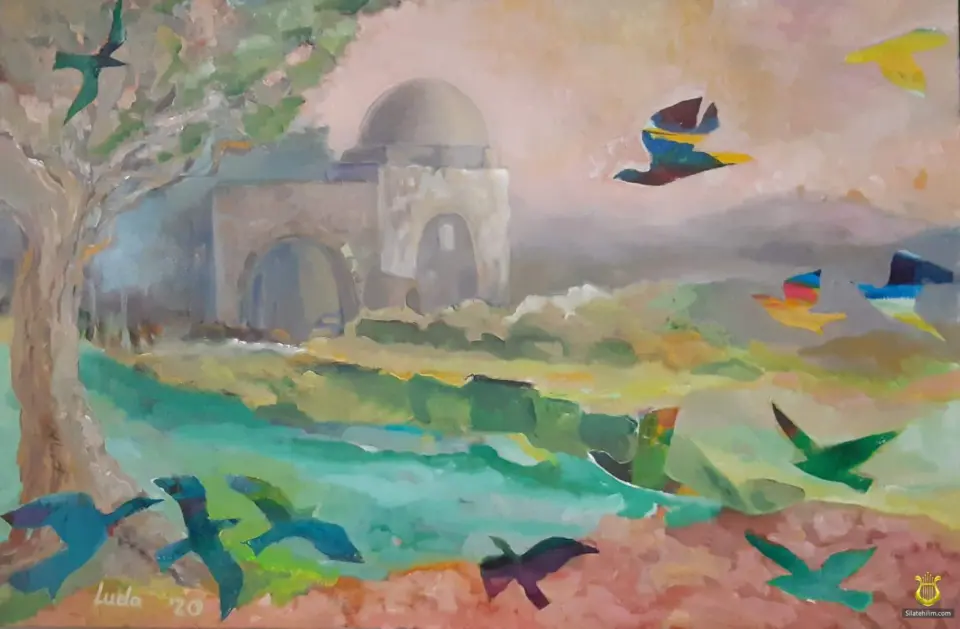
12. Never ask questions Rebbe Shimon Yaroslaver was niftar at the age of 91. At that time, few people lived so long. He was asked: —How did the Rebbe merit such longevity? He replied: —I never asked questions. When a person asks questions about how the Almighty governs the world, the Almighty answers: “Ascend to Heaven, and from there you will see that everything is for the best.” I never asked questions, so I was never summoned to Heaven to receive an answer. (Ohel Shimon, p. 17) [To be continued] (Based on classes by Rav Yisrael Yakovov; the books “At the Shabbat Table” by Rav Yaakov Doktor and “The Wisdom of Shlomo” by Rav Moshe Abramovich; and the magazine “The Well of Torah”) [P.S. The photograph features a work by Luda Miriam Shulman, provided to the site]