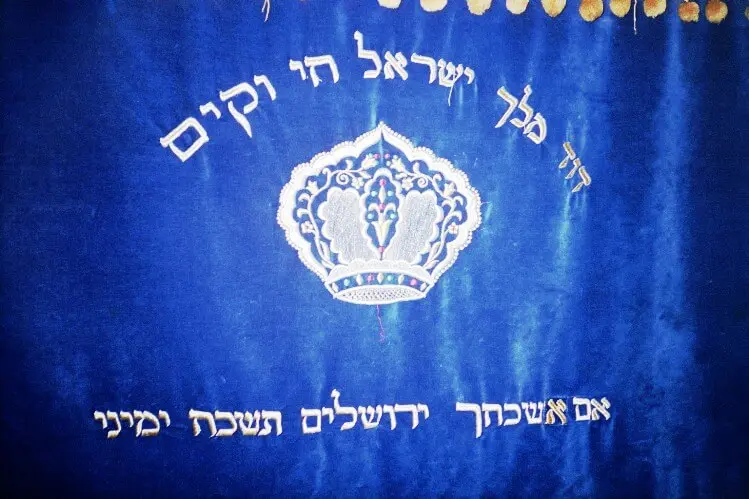
David Melech Yisrael Chai Vekayam
There is a great secret in the words: “David Melech Yisrael Chai Vekayam!” — (David lives and will exist forever, for all eternity). David HaMelech was careful throughout his life not to taste death. For sleep is one-sixtieth of death. David’s place is “chai”—life. King David never slept for 60 consecutive breaths. Even one breath less than 60 is completely “chai”—life. But beginning at 60 and beyond, a person tastes the flavor of death, and the spirit of impurity gains power over him. David HaMelech protected himself and did not taste death, so that the spirit of impurity would not rule over him, because 60 – 1 neshamot (breaths) = the secret of life above.
Up to 60, these are the 60 higher breaths on which Life depends. Beyond that lies the secret of death. Therefore, Rabbi Yehuda said that David slept like a horse—no more than 59 breaths. According to another opinion, King David never slept for more than half an hour, so according to Halakha he was not required to perform netilat yadayim (ritual handwashing). This is because impurity does not settle upon a person if he has not slept for half an hour.
Nevertheless, King David never once missed midnight—he would rise and study Torah until morning. From midnight onward he did not sleep or doze at all—he studied Torah and praised the Creator with psalms. When night came, he would sit with the leaders of the generation, examine legal cases, and study Torah. He did not go to sleep at the beginning of the night, but closer to midnight. At midnight he would rise and once again begin his service for the sake of the L-rd, praising Him and composing songs in His honor. When midnight arrives, the Higher Holiness awakens. And if a person sleeps, not hastening to behold the glory of his Master, it is as though he tastes the flavor of death. Therefore, studying at midnight is of great significance. Midnight is the time when HaKadosh Baruch Hu enters Eden to be with the righteous and studies Torah with them. This explains the midnight rectification—Tikkun Chatzot. (Zohar, Vayigash, Sulam, Zvi Nisan Zon)
The phrase “David Melech Yisrael Chai Vekayam!” — is recited on Rosh Chodesh and during Birkat HaLevanah, because according to gematria ראש חודש equals 819, as does דוד מלכ ישראל חי וקים.The Harp and King David
“David’s harp hung above his bed. At midnight, the north wind would arise, blow upon it, and it would play by itself.” A person is the Creator’s musical instrument. Our soul is called a “harp” (kinnor), and its strings tremble at the touch of light. This trembling is the care taken to bring pleasure to the Creator. David’s harp plays by itself because his soul is united with the Creator. We are all different, yet together we form an “orchestra” performing a symphony of light.
(Baal HaSulam, “Letters of Wisdom”)
The five-stringed harp corresponds to the Torah (the Five Books of Moses), and it is written in the Zohar: “Those who uphold the Torah are those who hold the harp.”
(Zohar, Tzav 32)
“The lungs have five sections (literally ‘ears,’ because they resemble ears in shape). For the spirit of life dwells in the lungs, and from there the spirit extends during a breath, as is evident to everyone. Therefore, the lungs have five sections, corresponding to the Five Books of the Torah, and to the five strings of David’s harp—the vessels of the spirit of life.”
(Likutei Moharan, Rabbi Nachman of Breslov)
The Root of David HaMelech’s Sin
The Sages of the Talmud (Sanhedrin 107) indicated that the root of King David’s sin was his excessive self-confidence: “Test me, O L-rd, try me!”—King David asked (Tehillim 26:2). After these words, the L-rd sent him the test involving Bathsheba, which David was unable to withstand. David’s sin taught him humility, and his profound repentance became an example for all generations of Jews.
Approximately 370 years passed between the Jewish people’s entry into their land and the birth of King David: 480 years passed from the Exodus from Egypt to the building of the First Temple. (Melakhim I, 6:1)
If we subtract 40 years (in the wilderness) and King David’s 70 years of life from this figure (as the construction of the Temple began after his death), the result is 370 years. This 370-year period spans four generations: Salmon, Boaz, Oved, and Jesse.
The place occupied by Moshe Rabbeinu among all the prophets is occupied by David, King of Israel, among all those who possess the spirit of holiness. Moshe Rabbeinu possessed the gift of prophecy at the highest level, and David had such a level of ruach hakodesh that no one could compare with him in this regard. It found expression in a work that has always and everywhere been regarded—and continues to be regarded—as an unsurpassed masterpiece of poetry: the book of Tehillim—“Psalms.” Since ancient times, none of the books of Tanakh has been read as frequently as this one. The book is divided into five sections, corresponding to the Five Books of Moses, as well as into seven portions corresponding to the days of the week, and into 30 days of the month. Whoever wishes may complete it in a week or a month. At times when special assistance from Above is needed, it is customary to recite a particularly large number of psalms. In editions of Tehillim, prayers are usually printed at the beginning and end—prayers recited before and after reading the psalms. They mention that the Names of the L-rd—known only to Kabbalists—are formed from both the initial and final letters of the words of Tehillim. Thus, when these words are recited, even without understanding their meaning, one invokes the L-rd through His hidden Names—and He responds! (Rabbi Yehuda Wexler)