The Secrets of Hair, the Part, the Forelock—and Why Women Do Not Grow Beards
The Secrets of Hair, the Part, the Forelock—and Why Women Do Not Grow Beards
Think back to childhood: why were there so many rules and instructions concerning hair—when to cut it, not to throw out hair that had fallen out (from combing or after washing) just anywhere, where and in what circumstances to cover one’s hair, and so on?
Why are there so many restrictions and prohibitions surrounding hair?
The Holy Zohar on Beha’alotcha says the following:
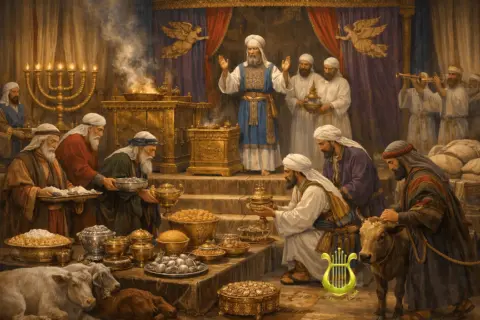
52) “Take the Levites, who must be purified and established in their place, on the left line, for they derive from the left arm, from the Gevurah of Zeir Anpin. And the side of judgment, and everyone who proceeds from the side of judgment, must not grow hair, since by doing so he increases judgment in the world.” And therefore a woman must ensure that her hair is not visible from the outside, and she must cover her head and cover her hair. Then all those who proceed from the side of judgment will be blessed. And therefore it is said concerning the Levites: “Do this to them in order to purify them... and let them pass a razor over their entire body. As we know, the Levites do not ascend to their place until the kohen raises them, because the right line always governs the left.”
53) The root of “se’arot” (hair) derives from the entry of the letter yud י into the light, when it removes the GAR, and the light “or” – אור becomes air, “avir” – אויר.
As a result of the deficiency of GAR, “hairs” - שערות grow—from the word “sa’aru” - סערו, judgments. For the impure side attaches itself wherever there is a deficiency.
And everyone who proceeds from the side of judgment must not grow hair, since by doing so he increases judgment in the world. However, this applies to those who proceed from the left line—that is, women, as well as the Levites. For those who proceed from the right side, from holiness, hair represents holiness instead.
For example, a nazir, who takes a vow and of whom it is said: “He shall be holy; he must let the hair of his head grow.” This is the entire distinction between holiness and purity.
Those who study the hidden Torah maintain that hair contains an immense, profound hidden energy.
The Holy Zohar regards every lock of hair as the “concealment of entire Universes.”
One of the deepest sections of the Holy Zohar, known as the Idra Rabba, in its commentary on Parashat Naso, is devoted almost exclusively to the subject of hair and its source in the Divine reality.
According to the Zohar, “...from a person’s hair you can know who he is.”(Zohar, Naso, Idra Rabba 129a)
Kabbalah discusses the paradox of hair: on the one hand, it is rooted in the tubular depression of the epidermis known as the hair follicle and nourished by blood vessels in the papilla, which extends into the follicle and the hair root. This makes it part of the body’s structure.
On the other hand, hair contains neither blood vessels nor nerves, and therefore causes no pain when removed from the rest of the body. (Or HaTorah, Parashat Emor, pp. 588–593)
Kabbalah teaches that hair functions like “straws” that transmit profound, inaccessible energy. Each lock of hair, shaped like a straw (the shape of the Hebrew letter ו “vav”), transmits a level of the soul’s energy which, because of its intensity, cannot be transmitted directly, but only through the “straw” of the hair.
Men’s Hair
Kabbalah distinguishes between “fine hair”, which adorns the top of the head and appears from birth, and the “coarse hair” of the beard, which appears only when a man enters adulthood. The hair that connects the “fine” and the “coarse” is the peyot—the hair that extends from the upper part of the head down along the jawbone, where it merges with the beard.
“Fine hair” represents deeply hidden energy emanating from the inner part of the head, which Kabbalah identifies as the seat of the superconscious.
The deepest and most primordial forces of our psyche, the soul’s supra-rational desires and yearnings, formed even before conscious awareness emerged, are associated in Jewish mysticism with that part of the head defined as the “crown above the brain,” or simply “Keter,” meaning crown.
Keter is considered the loftiest aspect of the soul and signifies a connection with G-d that transcends reason and logic.
The hair of a man’s beard, the “coarse hair,” represents energy emanating from subconscious impressions in the human psyche, situated in the upper and lower brain.
This is the mystical reason women do not grow beards.
The inner function of hair is to provide access, in a condensed and reduced form, to energy that is inaccessible because of its profound depth.
However, women by nature possess a level of cognition called “Binah”—understanding, inner intuition, and therefore do not require the “straws” of hair to access this level.
Peyot (sidelocks)—the two rows of hair that connect the hair of the head with the hair of the beard—symbolize in Kabbalah the condensed transmission of Keter’s superconscious energy to subconscious mental energy.
[For this reason, the Ari HaKadosh did not grow his Peyot below his ears, but left them hanging at the sides of his beard, as is customary among Yemenite, Moroccan (Eastern), and most Chassidic communities.]
The hair on the surface of the head, by itself (without further filtration through the Peyot), cannot transmit Keter’s energy because of its immense power. Therefore, the Torah instructs us to leave the Peyot and beards untouched, because they are vessels through which we gain access to the holiness of our souls.
The exception is the nazir—a person who, through a profound process of meditation and transcendence, seeks to return to the potential of his soul. Such a person, the Torah says, must allow his hair to grow, since each lock transmits and brings to the fore immense holiness and depth—the soul’s supra-rational connection with G-d.
Children’s Hair
This may be the deeper reason behind the Jewish custom of not cutting Jewish children’s hair until they are three years old. During the first years of a child’s life, his mind is not yet sufficiently mature to process all his experiences.
After the age of three, a child learns to interact more and more with the world around him. It is at this point that we should begin helping him build a bridge between his soul and his mind.
This is why we cut his hair and create a bridge—the Peyot—which carries the soul’s Keter energy to the lower part of his brain, so that when he grows up, he will have a beard. This is the moment when we create a connection between the greatness of his soul and the depth of his mind.
The Torah says that Mashiach will “break through the peyot of Moab.” (Bamidbar 24:17)
Moab represents wisdom and intellect. At present, we must preserve the Peyot in order to transmit supra-rational energy within the framework of rationality. But when Mashiach comes, the soul’s essential energy will come fully to the fore, in all its power, without requiring contraction and concealment through the Peyot. In this sense, our young children carry the light of Mashiach in their hair. (Rabbi Yosef Y. Jacobson)
When a person has his hair cut, he removes all judgments from himself with the help of a “ta’ar” (razor), whose numerical value is that of the Divine Name “Ad-nai.” This Name transforms judgments and has the numerical value of “ta’ar” (razor), in order to remove judgments.
“Ta’ar” (razor) is spelled tav (400), ayin (70), reish (200), for a total numerical value of 670, plus 1 (kolel) = 671.
“Ad-nai”: in its full spelling = 671.
The head contains allusions to the ten sefirot, while the allusions to Malchut constitute the secret of the sides of the head. Thus, “side” [in Hebrew, “pe’ah”] has the numerical value of the Divine Name Elokim, and “pe’ah” is always associated with Malchut.
“Pe’ah” is peh (80), aleph (1), hei (5) = 86.
“Elokim” is aleph (1), lamed (30), hei (5), yud (10), mem (40), also = 86.
The Divine Name “El”, in the secret of the Thirteen Attributes of Mercy, and the beard hair on the left and right together are twice the numerical value of the Hebrew word “beard” (zakan), which likewise has the numerical value of the Divine Name “Sha-dai.”
King David says in Tehillim (133:2): “It is like the good oil upon the head, running down upon the beard (ha-zakan), the beard (zakan) of Aaron...”“Zakan” (beard) is zayin (7), kuf (100), nun (50) = 157, and when doubled (right and left) = 314.
“Sha-dai” is shin (300), dalet (4), yud (10)—also = 314.
The entire beard is “E-l Sha-dai.”
For this reason, a person should always take care not to pull out hairs from it. (Adapted by Rabbi Zechariah Goldman from Ta’amei HaMitzvot, Kedoshim)Women’s Hair
Rabbi Zamir Cohen explains that according to Kabbalah, the hair that grows upward on the top of the head belongs to the attribute of justice—Gevurah—as opposed to beard hair, which grows downward and belongs to the attribute of kindness—Chesed.
According to the Holy Zohar, a woman is identified with Malchut, the receiving sefirah—in other words, a “vessel.” A man is Zeir Anpin—the giver.
When a Jewish man and woman marry, their neshamot (souls) become one, and together they form a complete system: the man now draws Light and Energy from the Universe and conveys it to the woman—for her, her husband, and their children.
How does she receive this energy? Through her hair.
A woman’s head hair (and a man’s beard hair and the hair on certain parts of his head) serves as a conduit for this Light and energy. By covering the hair on her head, a woman regulates this energy, restrains it, and “preserves” it for her family. When she does not cover her hair, this energy may escape or become unmanageable, creating difficulties for her and her family.
When a woman—whose essential nature lies in the sphere of judgment, Gevurah—marries and assumes the role of “akeret habayit” (homemaker), her head covering acts as a protective shield against supernal judgments. By covering her hair, she protects the entire household and draws an abundance of Rachamim to herself and her family. (Rabbi Zamir Cohen)The Part in the Hair
Interestingly, the Alter Rebbe writes in the Tanya that the Creator’s will, which requires Jews to fulfill the commandments in practice, is embodied in a spiritual substance whose counterpart in the human body is the head—or, more precisely, the part of it covered by hair.
The light strip of the part in the hair symbolizes the purest kindness of the Creator, while the hair on either side of the part represents the channels through which the Creator’s will is transmitted to the sefirot of the world of Atzilut. Upon reaching the Small Countenance, G-d’s will flows through all 613 channels.
Hair at the Crown of the Head
Once, a married couple came to Rabbi Levi Yitzchak of Berditchev (may the memory of the righteous be a blessing). They came to ask for help on behalf of their son, who had fallen in with a bad crowd and begun to turn away from the Torah. His parents had tried many times to speak with him—but without success.
Rabbi Levi Yitzchak listened to them and said that the young man’s hair should be cut—the forelock he had grown out should be removed.
The parents were very wealthy and were prepared to give their son anything he wanted, provided that he accepted the tzadik’s advice. The young man flatly rejected the offer and began slandering the tzadikim, so his parents had to approach the rabbi again.
Rabbi Levi Yitzchak then ordered them to tie up the young man, bring him to him, and cut his hair by force. Naturally, this left the parents bewildered. Some relatives were outraged: “Is this how one raises a child? We must not listen to this rabbi!” they said. Nevertheless, despite all the arguments, the parents understood that there was no other choice. They tied up their son, brought him to the Rebbe’s home, and cut off his forelock.
At that moment, a miracle occurred. As soon as the young man’s hair was cut, he immediately began to cry and repent, and asked the rabbi to allow him to become one of his students.
Many people were astonished by what had happened. They wondered what connection there could be between the young man’s behavior and his hair.
When Rabbi Levi Yitzchak was asked about it, he replied:
“But it is written in the Psalms of David! It says in Tehillim: ‘But G-d will crush the heads of His enemies, the hairy crown of the one who walks in his iniquities.’ This passage shows that there is a direct connection between the hair at the crown of the head and a person’s sinful deeds. That is why I said that the correction would be achieved by cutting his hair.”(Ahavat Chaim on Bereishit, Vayeishev)The Forelock
When a person grows a forelock, aside from the fact that the forelock itself is a symbol of pride, it also creates a problem with tefillin—for long hair in that place forms a living barrier between the body and the tefillin box. (Kaf HaChaim 27, Ben Ish Chai, Chayei Sarah, and Mishnah Berurah 107)(Compiled by Silatehilim from holy Jewish sources)
Was this helpful?
100% of readers found this article helpful (47 votes).
Please note: some articles on our site contain the holy Names of the Almighty. If you print these articles, they may not be thrown away or destroyed. Please handle printed copies with care and respect.
Material from our site may be copied for the purpose of spreading Torah, provided a link to Silatehilim.com is included. Any use of the site's material in print publications or for commercial purposes is prohibited without the rights holder's consent.